You have booked a dream stay at a remote lodge, but a nagging question keeps coming back: what happens when the lights go out, far from the nearest power grid? It is a fair concern. Lodge power outages are a reality in many of the world’s most beautiful and isolated places, from safari camps to highland retreats. The good news is that well-run lodges plan for them, and knowing how they cope makes the whole experience far less daunting.
This guide walks you through why outages happen in the first place, the backup systems lodges rely on, and what a cut actually feels like as a guest. You will also find practical advice on preparing before you book, choosing lodges that handle power reliably, and staying safe and comfortable during an outage. By the end, you will know exactly what to expect and how to pack for it.
Why Lodge Power Outages Happen in Remote Areas
Most remote lodges simply cannot plug into the national grid. They sit too far from towns and transmission lines, so they generate their own electricity using solar arrays, diesel generators or, increasingly, a hybrid of both. This independence is what allows them to operate in stunning locations, but it also means there is no utility company to call when something goes wrong.
Even lodges that are connected to the grid are not immune. In rural parts of Africa and in remote corners of the Scottish Highlands, local lines are often fragile and exposed to the elements. A single storm can bring down branches onto power lines, and repairs in sparsely populated areas can take hours or even days. Grid-connected lodge owners in these regions typically keep backup generation on hand for exactly this reason.
Load management: why the lights go off on purpose
Not every outage is an accident. Many lodges practice load management, which means they deliberately switch off power in guest rooms during certain parts of the day, usually around midday and late at night, to conserve battery reserves. With limited storage capacity, the priority is keeping essential lighting and refrigeration running around the clock. Understanding this changes how you see a midday blackout: it is not a failure, it is a planned part of how an off-grid lodge balances its energy budget.
Backup Systems Lodges Use During Power Outages
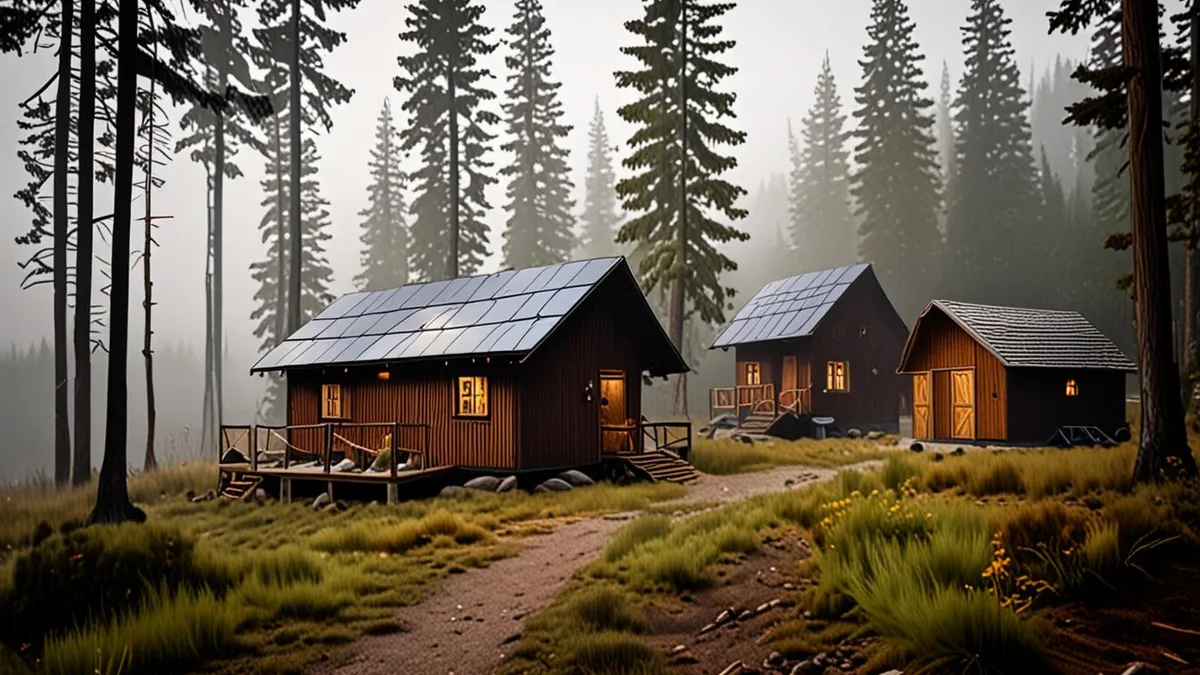
Good lodges build their power systems around redundancy, so a single failure rarely leaves guests in the dark. The backbone of most setups is a solar array feeding a bank of batteries, which keeps lights, fans and device charging running around the clock. Solar-plus-battery systems typically supply lighting and charging 24 hours a day, even when the sun is not shining.
When heavier loads are needed, such as kitchen equipment, laundry or water pumps, most lodges turn to a diesel or petrol generator. These typically run in scheduled windows, often roughly 6-9am in the morning and 5-10pm in the evening, recharging the battery bank and covering the demand that solar alone cannot meet. Quiet hours are respected outside these windows, both to save fuel and to preserve the peace that guests came for.
The switch between solar, battery and generator is handled by inverters, which smooth the transition so that most guests barely notice a cut. Lights may flicker for a second and then carry on as normal.
- Hot water rarely depends on electricity. Water heating is usually gas or solar powered, so hot showers typically continue even when the mains or generator is down.
- Refrigeration is treated as essential. Kitchen and bar fridges are usually connected to the battery bank or generator circuit so food and medication stay cold.
- USB ports are increasingly built into rooms. Even where standard outlets are limited, many lodges now fit low-draw USB charging points that work directly from the battery system.
- Backup fuel is stored on site. Lodges keep diesel or petrol reserves so generators can run for days if a delivery is delayed.
What a Lodge Power Outage Actually Feels Like for Guests
The first thing most guests notice during an outage at a remote lodge is how little actually changes. Lighting usually stays on via battery, so you can still read in bed and find your way to dinner. What disappears first are the high-draw appliances: air conditioning, hairdryers and kettles are typically the first things cut, because they drain batteries far faster than lights or fans. If you rely on a hairdryer or need boiling water for formula, ask staff what is available during generator hours.
Staying connected when the power drops
Connectivity is often the bigger surprise. Wi-Fi routers and nearby mobile towers frequently share the same limited power supply as the lodge, so your signal may drop just when you want to message home. Treat connectivity as a bonus rather than a guarantee, and download anything important in advance.
Charging is another adjustment. Outlets are often limited to the main lodge area or reception rather than individual rooms, so guests gather around a few sockets in the evening. Some rooms do have USB ports that work on battery power, but it varies by lodge. Meanwhile, life carries on comfortably: evening meals continue as normal, since lodge kitchens typically cook on gas, and dinner by lamplight often becomes one of the most memorable parts of the stay.
How to Prepare for Power Outages Before You Book
The single most useful thing you can do is ask the lodge directly how its power works. A short email before booking saves surprises: is power available around the clock, is the generator on a schedule, or is the lodge solar-only? Ask specifically about in-room charging, because outlets are frequently found in shared spaces like reception rather than beside your bed. Many lodges now fit USB ports in rooms even where full outlets are not available, so it is worth confirming that too.
Whatever the answer, arrive with your own backup. A power bank of 10,000-20,000 mAh covers 2-4 days of phone charging at an off-grid lodge, which is plenty for most stays. Beyond that, a few small items make a big difference to how comfortable an outage actually feels:
- Torch or headlamp — pack one per person rather than one per room, and choose a headlamp if you will be walking between your tent and the dining area after dark.
- Car charger — if you are on a self-drive trip, your vehicle becomes a charging station; a 12V USB adapter lets you top up devices at breakfast or before an evening drive.
- Offline downloads — save maps, podcasts, films and e-books before you lose signal, since Wi-Fi often shares the same limited power supply as everything else.
- Spare batteries — if your headlamp or camera takes AA or AAA cells, bring a spare set rather than assuming you can recharge anything on site.
If you want a fuller rundown of what else belongs in your bag, this practical lodge packing checklist covers the essentials from adapters to first aid.
Choosing Lodges That Handle Power Reliably
Not all lodges handle power the same way, and the differences usually track with price. Luxury and mid-range lodges more often run hybrid solar-generator systems with 24-hour power in every room, so you can charge a camera at 2am or run a fan through the night without thinking about it. If that level of reliability matters to you, it helps to understand how the different safari lodge tiers compare before you commit to a booking.
Budget and community-run lodges are a different story. They are more likely to run a generator on a schedule and to ask guests to charge devices at a shared station in the main area. That is not a flaw — it is often how these lodges keep rates affordable and reduce fuel use — but it changes how you plan your evenings and your packing.
Read reviews with power in mind
Guest reviews are one of the most reliable signals of what to expect. Search them for phrases like “constant power”, “solar” or “generator at night”. If several recent guests mention 24-hour electricity or complain about midday cut-offs, you have a realistic picture before you arrive.
Also check the lodge’s own facilities page. Lodges that have invested in solar usually advertise it as a selling point, listing battery systems, inverter backup or USB ports in rooms. If a lodge says nothing about power at all, that silence is itself information — email them and ask before you book.
Safety and Comfort During an Outage at a Remote Lodge
When the lights go out at a remote lodge, the right response is calm and quick: tell a staff member. Lodge teams deal with outages regularly and know whether it is a scheduled generator change, a tripped circuit or something needing the technician. Do not open electrical panels, fiddle with inverters or approach the generator shed yourself — these systems are unfamiliar, sometimes poorly labeled and occasionally wired in ways you would not expect.
Think ahead about your phone, too. It is your lifeline for calling reception or, in a genuine emergency, outside help. A simple habit makes a big difference: top your phone up each evening so you go to sleep with plenty of charge, even if the room outlet goes dead overnight.
- Skip candles entirely — many lodges prohibit open flames in thatched or timber buildings for obvious fire reasons, so use your torch or headlamp instead.
- Flag refrigerated medication early — insulin and similar medicines should go in the main lodge fridge, which stays on backup power, rather than a room minibar that may not.
- Keep a light within arm’s reach of your bed — if you wake in the dark, you can find your way without stumbling on a step or a safari chair.
- Note the emergency procedure at check-in — ask which radio channel, phone extension or whistle signal staff use after dark so you know how to raise help quickly.
Handled this way, an outage stays a minor inconvenience rather than a safety issue. Staff would much rather answer a small question at 9pm than deal with a guest who tried to fix a generator in the dark.
Wrapping Up: Power at Remote Lodges
If you have booked a remote lodge and worried about losing electricity far from the grid, the short answer is reassuring. Lodges in these areas plan around outages with solar arrays, battery banks and scheduled generator hours, so lights and device charging usually continue even when the mains are down. You are far more likely to notice limits on Wi-Fi, outlets and high-draw appliances like air conditioning than to sit in total darkness.
In practice, a power bank of 10,000-20,000 mAh, a headlamp and one direct question to the lodge before booking cover most of the risk. Ask whether power is 24-hour or generator-scheduled, and you will know exactly what to expect. If you have stayed at an off-grid lodge with a memorable power story, or you have tips of your own, leave a comment below or share this article with a fellow traveler.