Few travel disappointments sting like arriving at a rented villa and finding three steps at the front door, a gravel driveway and a bathroom you cannot turn a wheelchair in. Villa accessibility is rarely what the listing says: the word “accessible” gets used loosely, and photos are framed to hide exactly the barriers that matter most to travelers with mobility needs.
This guide walks you through the questions that uncover the truth before you pay. You’ll learn why listings overstate accessibility, what to ask about entrances, doorways and floors, and how to pin down bathroom and bedroom details that decide whether the trip works at all. We’ll also cover pools and terraces, how to get accessibility promises in writing, when to book and what local support to line up. Measure, verify and document, and a villa stay becomes far more predictable.
Why Villa Accessibility Is Rarely What the Listing Says
Ask ten villa owners what “accessible” means and you’ll get ten different answers. For many, it simply means there is a bedroom on the ground floor. That single feature tells you almost nothing about whether a wheelchair user can actually shower, cook or reach the terrace. The word carries no standard definition in private villa rentals, unlike hotels that may follow recognized accessibility guidelines, so every claim needs to be unpacked.
There’s a second problem: owners often genuinely don’t know. Many rent out family properties through an agent and have never measured a doorway or counted the steps to the pool. Ask for the width of the bathroom door and you may get a guess, a pause, or a photo taken at an angle that hides the answer. That’s not dishonesty, but it does mean you can’t rely on memory. You need measurements.
What photos conveniently leave out
Listing photos are shot to sell the view, not to document barriers. Gravel driveways that vibrate a manual wheelchair apart rarely appear on camera. In European villa listings, a gravel driveway and 3-5 exterior steps at the entrance are the most common hidden barriers, and neither shows up in a sunset shot of the infinity pool. Sunken living rooms, split-level terraces and a single step between indoor and outdoor floors are equally invisible.
The practical takeaway: treat every accessibility claim as unverified until you’ve seen it measured, photographed or filmed yourself. The rest of this article gives you the exact questions to ask, starting with entrances and floors.
Questions to Ask About Entrances, Doorways and Floors
Entrances and floor layout decide whether a villa works at all, so start here before you fall in love with the view. Ask the owner or manager directly for the exact number of steps at every entrance, including side and terrace doors you might use as an alternative way in. If there are steps, ask whether a portable ramp exists on site, how steep it is and who installs it. Many owners will say “yes, we can arrange a ramp” without ever having checked whether the entrance is physically suitable for one.
Then move inside and ask for doorway measurements in centimetres, not adjectives. Doorways of at least 80 cm and hallways of 90 cm or wider suit most wheelchairs, but plenty of older European villas have doors in the 60-70 cm range that no wheelchair passes through comfortably. Also confirm in plain terms that the bedroom, bathroom and kitchen all sit on one floor with no internal steps between them, including a single step at a sliding door.
Our complete villa rental checklist covers the general questions every renter should ask; here are the mobility-specific ones to add:
- Thresholds, not just doors: a raised threshold or sliding-door track of even a few centimetres can stop a wheelchair, so ask for its height.
- Turning space in hallways: a long corridor with a 90-degree turn needs extra width at the corner; ask whether a wheelchair can make the turn without reversing.
- Elevator or lift, if the villa has floors: ask for its dimensions, weight limit and whether it’s a real lift or a stairlift chair.
- Parking details: confirm the spot is level, paved and close to the entrance, and ask the actual walking or rolling distance in meters.
- Furniture placement: ask whether beds and tables can be shifted to widen pathways before you arrive.
Bathrooms, Showers and Bedrooms: The Details That Decide the Trip
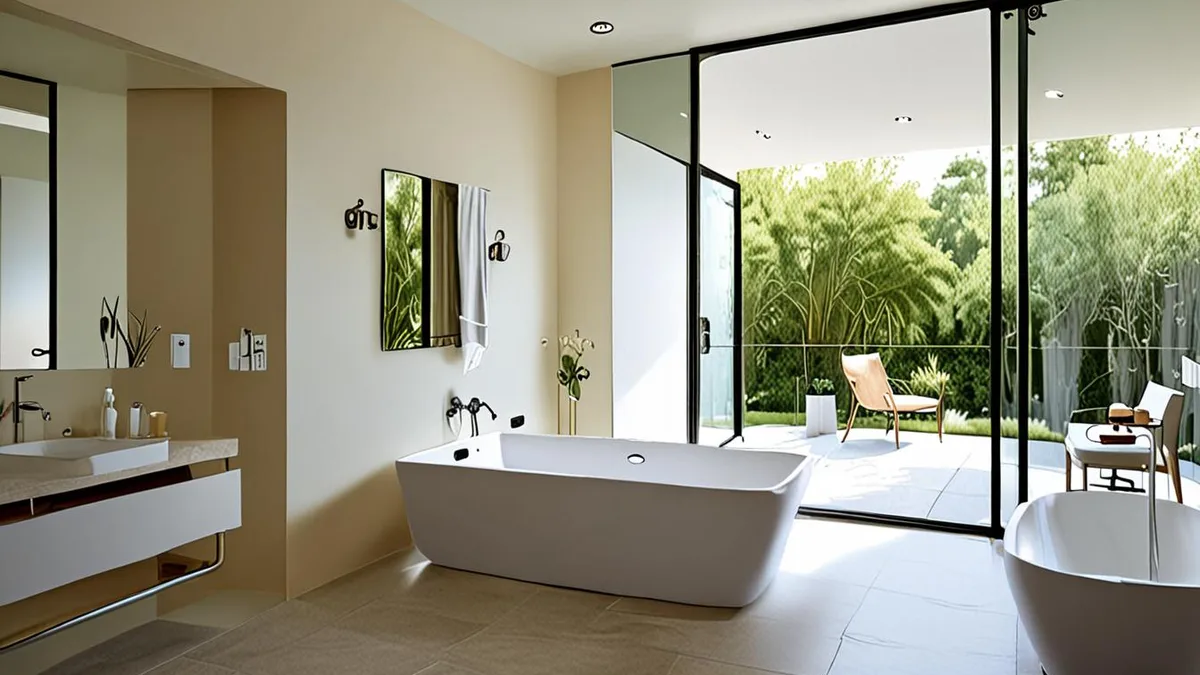
If the entrance is the first hurdle, the bathroom is the one that ends trips. The single most important phrase to use is “roll-in shower with a fold-down seat.” A “walk-in shower” in listing language often means a tray with a lip of five or ten centimetres, or a step over the edge, which is unusable for many wheelchair users and risky for anyone with limited balance. Ask explicitly whether the shower floor is completely level with the bathroom floor and whether the seat is fixed or fold-down.
What to ask for photographic proof of
Words like “adapted bathroom” mean little without evidence. Request photos of the grab bars and where they’re mounted, the toilet and its height, and the open floor space around both. Ask for the turning space to be at least 150 cm in diameter, which allows a wheelchair to rotate fully; a bathroom that’s technically step-free but too narrow to turn around in still requires reversing out blind. A short phone video of the bathroom often answers more questions than a dozen staged photos.
Bedrooms deserve the same scrutiny. Ask for the bed height from floor to the top of the mattress, since transferring is far easier from a bed at a similar height to the wheelchair seat. Confirm whether staff can adjust furniture before arrival: moving a bed away from the wall, removing a thick rug that blocks wheels or relocating a low coffee table can transform a room. Also ask whether the bedroom door opens wide enough with the door fully open, and whether there’s space to position a wheelchair alongside the bed on the transfer side. These details take five minutes to check by message and can make the difference between an independent stay and a frustrating one.
Pools, Terraces and Outdoor Spaces for Wheelchair Users
The pool is usually the reason you booked the villa in the first place, so it deserves the same scrutiny as the bathroom. Here is the hard truth: most private villa pools have no hoist, no ramp and no zero-entry point. That is not a dealbreaker for everyone, but if transferring in and out of the water is difficult, you need to know before you arrive, not after.
Ask the owner directly whether the pool offers any assisted entry at all. If it does not, factor in the cost and logistics of renting a portable hoist or a beach-style wheelchair locally, since these are rarely kept on site and usually need to be arranged in advance. It also helps to understand what kind of pool you are actually getting, so read up on the different types of private villa pools and how they are built before you commit.
Outdoor surfaces matter just as much as the water. A terrace that looks flawless in photos can turn out to be loose gravel, uneven cobbles or a deck with a raised threshold at every door. Smooth stone, level tiling and well-laid decking roll easily; gravel and cobbles genuinely do not, no matter how sturdy the wheelchair.
- Ask for close-up photos of the pool edge, since a raised coping stone of even a few centimeters can block a wheelchair from getting parallel to the water.
- Request a description of the route from the main entrance to the pool, including any slopes, and how steep they are.
- Confirm there is a shaded seating area reachable without steps, because sun exposure and heat management are real safety issues for many travelers with mobility needs.
- Check whether outdoor furniture is fixed or movable, since a lightweight chair and table can be repositioned to create a comfortable transfer point.
- If the villa has split-level terraces, ask exactly where the level changes are and whether any ramp exists between them.
Getting It in Writing: Verifying Claims Before You Pay
Photos can be cropped, angles can flatter and the word “accessible” costs an owner nothing to type. A short video, on the other hand, is hard to fake and easy to request. Before you pay any deposit, treat verification as part of the booking process, not an awkward afterthought. A few messages now can save you from arriving at a villa that looks nothing like the listing.
- Ask for a video walkthrough of the three critical spaces. Request a continuous, unedited clip of the entrance, the bedroom and the bathroom, filmed at walking pace. A single take makes it much harder to hide the step between the hallway and the living room that never appears in the gallery photos.
- Get the key promises written into the booking confirmation. Verbal assurances disappear the moment there is a dispute. Ask the owner or agent to state explicitly, in the confirmation itself, that the villa offers step-free entry, a ground-floor bedroom and a roll-in shower, or whatever combination matters most to you.
- Agree in advance on who to contact on arrival day. Find out the name and phone number of the person responsible if a promised feature is missing, and ask what remedy is offered, whether that is a portable ramp delivered, an alternative room or a partial refund. Knowing this before you travel turns a stressful arrival into a solvable problem.
Timing matters as much as wording. Reach out to owners directly rather than relying on booking platforms, and start the conversation well ahead of the June-September peak, when accessible villas tend to be reserved first. Early contact also gives owners time to measure doorways, film the bathroom or move furniture before you commit.
Owners who respond promptly and willingly to these requests are usually the ones whose villas genuinely work for wheelchair users. Hesitation, vague answers or a refusal to film the bathroom are useful signals too, and they cost you nothing but a message. If one owner stonewalls, move on to the next listing rather than hoping for the best.
Timing, Staff Support and Local Backup for Mobility Needs
Accessible villas are a small slice of the market, and they book out first. If your trip falls in the June-September peak season, contact the owner or manager directly at least 2-3 months ahead. That lead time gives you room to measure doorways, request a video walkthrough and walk away without panic if the answers do not add up. In shoulder season you have more flexibility, but the same questions still apply, and early contact almost always gets you a more thorough response than a booking made a fortnight out.
What the staff can and cannot do
Many villas come with housekeeping or a cook, and in some cases they can genuinely help with daily tasks, from preparing meals in a kitchen you cannot easily reach to moving furniture or rugs before you arrive. The crucial detail is whether staff can actually reach the floor you will be living on. If your bedroom and bathroom are on the ground floor but housekeeping works only upstairs, or vice versa, the practical support you were counting on may not materialize. Ask directly who will be on site, which days they work and whether they can assist on the guest floor. To understand typical arrangements, it helps to read about what villa staff actually do, from housekeeping to cooks and concierge services before you set expectations.
Line up local backup before you book
The villa itself is only half the equation. Before paying a deposit, research whether you can rent equipment such as shower chairs, hoists or beach-style wheelchairs in the nearest town, since pool hoists in particular are rare in private villas and usually need to be sourced locally at extra cost. Check the distance to physiotherapy clinics, pharmacies and the nearest medical facility, and note how you would reach them, since not every rural villa sits on an accessible transport route. A short phone call or email to a local rental company while you are still deciding can save you an entire holiday’s worth of improvising, and it tells you a lot about how realistic the owner’s promises are.
Booking an Accessible Villa With Confidence
Booking an accessible villa with confidence comes down to one habit: verify everything yourself. The word “accessible” on a listing tells you almost nothing, so treat it as a starting point, not an answer. Measure the details, ask for the video walkthrough, and get the three essentials in writing: step-free entry, a ground-floor bedroom and a roll-in shower. When those promises sit in your booking confirmation, you have something to point to if anything falls short on arrival day.
Timing matters just as much as questions. Reach out early, ideally 2-3 months before the June-September peak, and line up local support such as equipment rental or nearby medical services before you pay. Do that, and you can arrive knowing the villa matches your needs instead of hoping it does. If this guide helped you plan, leave a comment or share it with a fellow traveler.