A villa that sleeps ten on paper can still leave half your group on sofa beds. Listings love to count every fold-out and convertible toward capacity, but that tells you little about actual villa bedrooms and sleeping arrangements. If four couples and two singles are traveling together, the difference between five real bedrooms and three bedrooms plus two convertibles can make or break the trip.
This guide walks you through matching bedrooms to the people who are actually going. We cover why listings rarely match reality, how to allocate rooms between couples, singles and friends, what works for families with children, and how to treat sofa beds, annexes and other overflow spots. You’ll also find advice on bathrooms and bedroom locations, a checklist for verifying everything before you pay, and a final summary to keep handy when you book.
Why Villa Bedrooms and Sleeping Arrangements Rarely Match the Listing
The fastest way to get disappointed is to take a listing’s capacity figure at face value. Most villas count every sleeping spot toward the total, including sofa beds in living rooms, fold-outs in offices, and single mattresses that appear only when needed. A sleeping spot is not a bedroom, and your group will feel the difference within one night.
Consider a typical “10-person villa.” It may have only 4 real bedrooms, with the remaining capacity coming from two convertibles tucked into a lounge or study. That works on a spreadsheet. In practice, two adults sleeping on a sofa bed in a shared living space is a very different experience from having a room with a door, a wardrobe and some privacy.
What counts as a real bedroom
A true bedroom usually contains a window, a wardrobe and a proper bed, not a convertible. When comparing villas, count bedrooms using that definition rather than the number in the headline. If the listing is vague, ask the host directly how many genuine bedrooms there are and what the remaining sleeping spots actually are.
Photos are another trap. Hosts naturally showcase the best bedroom: the one with the view, the four-poster bed or the en-suite. The twin room next to the garage rarely makes the gallery. Before you book, ask for photos of every sleeping space, including the sofa bed made up and the room it sits in. A host who answers quickly and honestly is also a good sign for the rest of your stay.
Matching Bedrooms to Couples, Singles and Friends
Once you know how many real bedrooms a villa has, match them to your group’s makeup. The basic rule is simple: each couple needs its own bedroom. Sharing a room with another couple might have worked at 22, but on a two-week holiday it wears thin fast. Singles are usually more flexible, and many will happily take a twin room, or even a sofa bed, to keep their share of the cost down.
Friends’ groups have a harder job than families because nobody has a natural claim on a room. Agree upfront who gets doubles, who gets twins, and who takes the worst room, ideally before anyone pays a deposit. If you want a fuller framework for budgeting and splitting costs, the guide on how to rent a villa for a group covers rooms, costs and bill-splitting in detail.
As a target, aim for one bedroom per pair or single. In practice, groups of 8-12 people usually need 4-6 genuine bedrooms for a comfortable stay. A few points worth settling with your group:
- Decide whether the largest or best-located bedroom goes to a couple who pays the same share as everyone else, or whether you adjust contributions for the premium rooms.
- If two singles will share a twin room, check the beds can be pushed apart or are genuinely separate singles, not a double with a divide.
- Give the person on the sofa bed a small discount on their share; a token saving keeps goodwill alive far better than a flat split.
- Put the room allocation in your group chat in writing before booking, so nobody can relitigate it on arrival.
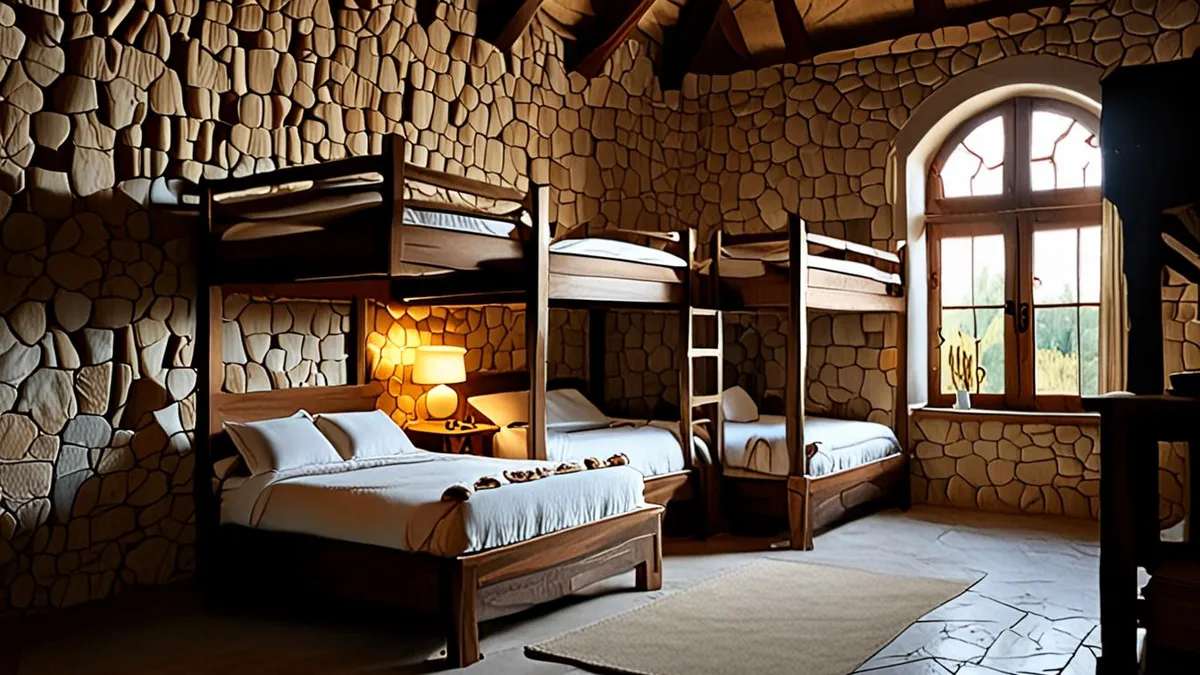
Sleeping Arrangements for Families with Children
Families with children need a different calculation than groups of adults. A family of four with young kids often shares one twin room, with parents and children in separate beds, which frees up bedrooms for the rest of the group. Alternatively, they take a double plus an adjacent kids’ room, which gives everyone better sleep if the layout allows it. Ask whether the kids’ room genuinely adjoins the parents’ room or simply sits down the corridor.
Bunk and quad rooms look like a bargain in photos, and for good reason: they work well for children up to about 12 years old. What suits a nine-year-old rarely suits an adult, though. A 45-year-old on a top bunk in a small quad room is a recipe for a bad back and a short temper, so don’t count these rooms toward adult capacity.
If you’re traveling with babies or toddlers, check cot and highchair availability early. Many villas supply them on request at no extra cost, but stock is often limited, and the best villas in peak season run out. A few practical checks before you book:
- Ask whether cots are proper travel cots or fold-up models, and whether linen for them is included.
- Confirm whether a highchair, sterilizer or baby bath is available, since renting these locally can be a hassle.
- Check whether stair gates or pool fencing can be fitted if you have mobile toddlers; pool safety varies a lot between villas.
- Find out how far the kids’ room is from the parents’ room, because a hallway away is fine for older children but not for a two-year-old.
Sofa Beds, Annexes and Overflow Sleeping Spots
That “sleeps 12” figure often includes a sofa bed folded out in the living room. Treat any living-room sofa bed as overflow for one or two adults at most, not as a main bedroom. Sleeping there usually means the least privacy, the most noise from the kitchen and terrace, and the first wake-up call when someone else gets up early. It works fine for a night or two, or for a single who is happy to trade privacy for a lower share of the rental cost.
Separate annexes and guest houses are a different story. These self-contained spaces, often above the garage or at the edge of the garden, suit teenagers who want independence or grandparents who go to bed early and don’t want to climb the main staircase. They can also be a smart spot for the friend who arrives a day later than everyone else.
Questions to ask about an annexe
Before you count an annexe as a proper bedroom, confirm the details in writing. Ask the host these two things specifically:
- Does it have its own bathroom? An annexe with no bathroom means nighttime trips back through the garden or into the main house, which quickly loses its charm.
- Does it have its own air conditioning or heating? Detached spaces are often converted garages or storerooms, and temperature control is not guaranteed. Check what climate control is actually installed.
If the annexe ticks both boxes, it can genuinely count as a bedroom when you plan who sleeps where. If it doesn’t, mention it honestly to your group before anyone claims it.
Bathrooms, En-Suites and Bedroom Locations
Bedroom location inside the villa matters as much as the bed itself. A beautiful room at the top of three flights of stairs is a poor match for an older guest or anyone with mobility issues, so check whether at least one comfortable bedroom sits on the ground floor. Many larger villas have one, but some don’t, and it’s far better to know before you book than after your father-in-law has hauled his suitcase upstairs.
Think about noise too. Bedrooms that open straight onto the pool terrace tend to be lively in the evening, when others are still swimming, chatting or playing music after dinner. Light sleepers should look for rooms on the quieter side of the villa, away from the pool and ideally away from the kitchen or outdoor dining area.
When you compare villas, work through a short checklist of location details:
- Stair count to each bedroom. Ask how many flights separate each room from the living areas and pool, since a ground-floor room and a third-floor room are very different propositions for the same group.
- Which bedrooms have en-suite bathrooms. En-suites appear in roughly half of villas with 4 or more bedrooms, so confirm exactly which rooms have one and which rely on a shared bathroom down the hall.
- Distance from the pool terrace. A room whose doors open directly onto the pool deck will pick up every splash and conversation; a room on the opposite side of the house usually stays quieter.
- Proximity to the kitchen and dining area. Rooms next to the kitchen hear early-morning coffee makers and late-night dishwashers, which matters for anyone who values a lie-in.
Share this checklist with your group and let people with specific needs claim their rooms first. It avoids the awkward scramble on arrival day.
How to Verify Sleeping Arrangements Before You Book
Villa photos and descriptions rarely tell the whole story about who sleeps where. A listing can look perfect online, then fall apart the moment you realize the “fourth bedroom” is actually a sofa wedged next to the kitchen. Before you pay a deposit, take a few deliberate steps to pin down the real sleeping arrangements. It takes one or two emails and saves a lot of holiday friction later.
- Request a floor plan in writing. Ask the host or agent for a floor plan showing every room, and ask for the bed sizes in each one — king, double or twin. A true bedroom should have a window, a wardrobe and a proper bed, not a convertible. Written confirmation means the “double bedroom” can’t turn out to be a fold-out sofa when you arrive tired after a long drive.
- Match the plan to your group. Lay the confirmed rooms against your list of couples, singles and families. Check that every couple gets a genuine bedroom and that the number of real bedrooms — usually 4-6 for a group of 8-12 — matches what you actually need. While you’re at it, ask which bedrooms have en-suite bathrooms, since these appear in roughly half of 4+ bedroom villas and the allocation matters to your group.
- Book early for peak summer travel. If your trip falls in July or August and you need a villa with 4 or more bedrooms, aim to book 6-9 months ahead. Large villas in popular regions are scarce and the best ones go first, so waiting rarely pays off.
- Confirm cleaning and linen changes before paying. For larger groups, ask the host directly how often cleaning happens, whether linen and towel changes are included, and whether mid-stay cleans cost extra. Get this in writing too, since services for big groups vary a lot between properties.
Once you have written answers to all of these, you can commit to the booking with confidence. Circulate the floor plan to your group straight away, so everyone knows exactly which room is theirs long before the suitcase-packing even starts.
Getting the Right Rooms for Your Group
There is often a big difference between a villa that claims to sleep ten and one that genuinely houses ten people in comfort, and the trick is to count proper bedrooms rather than trusting the listed capacity. Before you commit to anything, think about how each room will actually be used: who will sleep where, and whether that arrangement will still feel fair on the fifth night of the trip.
Getting this right takes a little homework. Ask the host for a floor plan showing bed sizes in writing, find out which bedrooms come with en-suites, and clarify exactly how sofa beds and any annexe fit into the overall setup. It also helps to have an honest conversation with your group before booking, so everyone knows which room they are getting and nobody feels shortchanged on arrival night.
A handful of questions up front can spare your group a lot of bed-shuffling and grumbling later. If this helped you plan a group villa stay, leave a comment or share the article with your travel companions.