Every parent knows the drill: the resort website shows a smiling toddler by a sparkling pool, but on arrival you discover the “family room” barely fits a crib, the kids club shut for the season, and the pool has no shallow end. If you want to choose a family resort without burning money and patience, you need to look past the photos and ask specific questions before you book.
This guide walks you through exactly what to check, step by step. We’ll start with matching the resort to your kids’ ages, then cover room types and layouts that actually fit a family, what to verify about kids clubs before you commit, and the pool, beach and balcony safety checks that matter most. We’ll also break down when all-inclusive meal plans pay off, how to pick a destination that suits a family trip, and finish with a simple checklist you can use on any booking page.
How to Choose a Family Resort: Start With Your Kids’ Ages
The single biggest mistake families make is booking a resort because it looks great online, then discovering on arrival that almost nothing suits their children’s ages. A place designed for toddlers is a very different property from one built around teenagers, and the brochure photos rarely make that clear. So before you compare pools or restaurants, sit down and be honest about what your kids can actually do.
If you’re traveling with children under 4, forget kids clubs entirely. Most clubs simply don’t accept this age group, and under-4s usually need paid babysitting or a parent present anyway. What matters instead is practical baby infrastructure: cots you can pre-book rather than hope for, a way to warm bottles and milk in or near your room, effective blackout curtains for naps, and pool areas that are securely fenced. Ask the resort directly about all four before you pay.
The sweet spot: ages 4 to 12
Children in the 4-12 range are who family resorts are really built for. This is the age band where supervised clubs and group activities work well, and where a good program genuinely gives parents a break. Look closely at how many hours a day the club runs and whether the activities match your child’s personality, since a shy six-year-old and a sport-mad ten-year-old want very different things.
Teens are the group most often forgotten. A 14-year-old will not thank you for a puppet show, so check specifically for teen programs: gaming rooms, sports courts, water sports, or at minimum a hangout space with Wi-Fi and other kids their age. If the website only mentions a club for younger children, assume your teenager will be bored by day two.
The bottom line is simple: match the resort’s age focus to your family, or you’ll end up paying for facilities you never use. A teen-heavy resort with no toddler facilities wastes money for families with a baby, and vice versa. One email to the resort listing your children’s exact ages will tell you more than any photo gallery.
Room Types and Layouts That Actually Fit a Family
The single biggest mistake families make is booking a “family room” without checking what that actually means. In practice, it often turns out to be a standard double room with a fold-out sofa squeezed against the wall. For a family of four, aim for a proper family suite or connecting rooms with at least 25-30 sqm of space. Anything smaller feels fine on arrival night and progressively worse by day three, when suitcases, wet towels and a toddler’s energy all need somewhere to go.
Bed configuration matters just as much as floor space. A sofa bed that’s comfortable for two nights can be miserable for a week, especially for older children who notice every spring bar. Look for rooms with real single beds or twin beds for the kids, and ask the resort to describe the exact setup rather than relying on photos, which rarely show the sofa opened up.
Beyond beds and square meters, a few features quietly make or break a family stay. A separate sleeping area is the big one: if the kids fall asleep at 7:30 pm and you’re sitting in the dark three feet away, your evenings are over. A balcony gives you somewhere to talk, read and drink a glass of wine without whispering. A fridge handles milk, snacks and leftover fruit, and a kettle covers baby bottles and emergency pasta for fussy eaters.
One last check before you pay: occupancy rules. Many rooms marketed as family rooms legally cap at 2 adults plus 2 children, and some resorts count babies toward that limit. If your family doesn’t fit the standard formula, email the resort directly and get the answer in writing.
- Connecting doors come in two types: a real internal door between rooms gives privacy and sound separation, while an “adjoining” setup with just a shared wall is not the same thing, so ask which one you’re getting.
- Ask for the bed sizes in centimeters: a “double sofa bed” can range from a cramped small double to a proper queen, and the difference decides whether two kids actually fit.
- Request a room away from the pool bar and evening entertainment: noise travels, and a family with early bedtimes will regret a room above the stage or beside the swim-up bar.
- Check the bathroom layout: two families of four can share one bathroom, but a separate toilet or a second sink dramatically cuts morning queues with kids.
- Confirm whether a cot replaces a bed or adds to occupancy: some resorts count a cot-occupying baby in the room’s maximum, which can block a booking for families of five.
Kids Clubs: Ages, Hours and Staff Ratios to Check
The kids club can make or break a family holiday, so it deserves more than a glance at the brochure photo. Most resort clubs accept children aged 4-12, which matches the ages where kids actually want to join in. If you have a child under 4, the club usually won’t take them; instead, expect paid babysitting or a requirement that a parent stays in the room with them. Ask about this before booking, not at check-in, because babysitting hours and costs vary widely between resorts.
Staff ratios and opening hours
Ratios matter more than colorful playrooms. For ages 4-8, look for roughly 1 carer per 5-8 children. If a resort can’t tell you its ratio, treat that as a warning sign and ask follow-up questions about supervision during pool-based activities in particular.
Hours are the other big divider. A full-day club running roughly 9:00-17:00 genuinely frees up your holiday: you can book a spa treatment, do a long lunch or take an older child on an excursion. A half-day club, or one that closes for a long lunch break, sounds good on paper but rarely gives you a usable block of time. Check whether the club runs every day of your stay, since some operate reduced schedules outside peak season.
Finally, get clear on cost and booking. Some clubs are free and drop-in, others charge per session or per day, and many require advance reservation during school holidays when demand spikes. If you’re traveling in a busy week, reserve spots as soon as the resort allows it, and confirm whether lunch inside the club counts as part of the session or costs extra.
Safety Checks Before You Commit: Pools, Beaches and Balconies
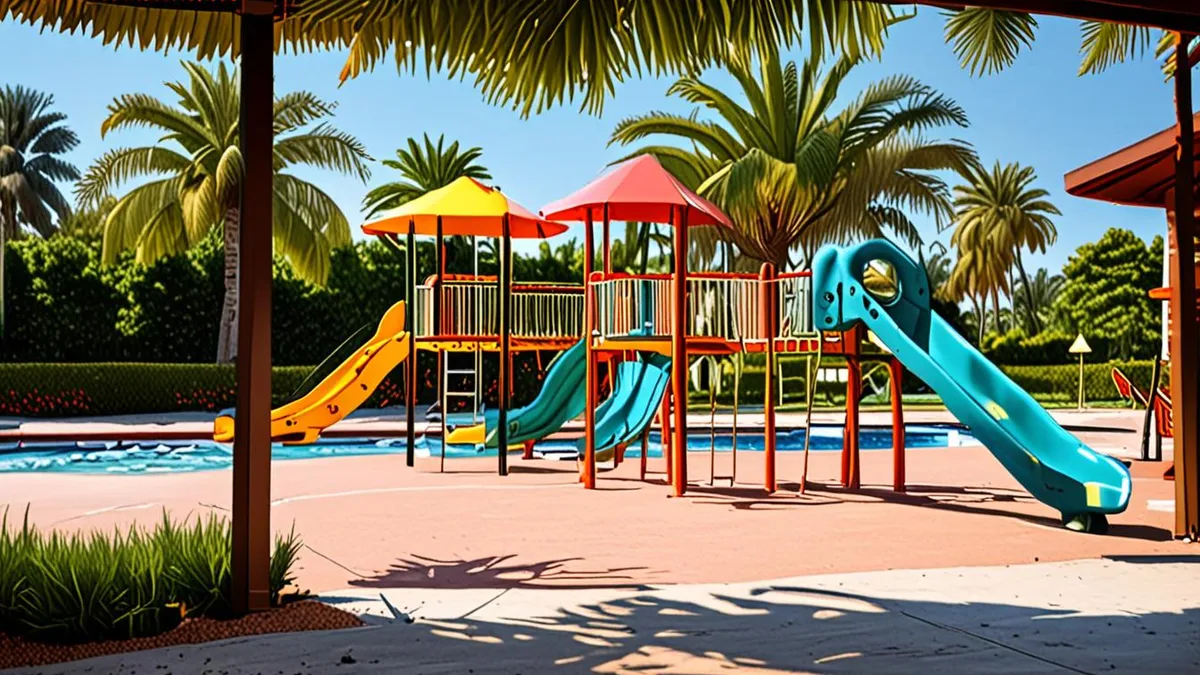
Water is the number one safety concern at any family resort, so start with the kids pool. Ideally it should be no deeper than 40-60 cm, clearly separated from the main pool by fencing or a solid barrier rather than just a rope. A shallow toddler pool that sits directly beside a 2-meter deep pool defeats the purpose, because a curious three-year-old will wander.
Next, ask the resort directly about lifeguard coverage. Some resorts staff pools only during peak hours, and many beach areas have no lifeguard at all. Also check that pool depth signage is visible at the pool edge, since this tells you how seriously the resort takes safety in general.
For beach destinations, look at photos or read reviews to find out how the seabed behaves. A beach that shelves gently lets kids splash safely for meters, while one that drops off quickly after a few steps is far riskier for under-8s, especially with any surf.
Balconies and windows matter more than most parents expect. Balcony railings should be high enough that a small child cannot climb over, and the bars should be close enough together that a toddler’s head cannot fit through. Window locks are just as important on upper floors.
Finally, baby equipment should be certified and guaranteed, not a lottery. Before you pay, ask these questions:
- Are cots and bed rails certified to current safety standards, or old hand-me-downs of unknown origin?
- Can you pre-book a cot, stair gate or high chair at the time of booking, or is it first-come, first-served on arrival?
- Does the resort provide door alarms or pool alarms for rooms that open directly onto a pool area?
- Is there a doctor or medical point on site, and how far is the nearest clinic or pharmacy?
A resort that answers these quickly and precisely is usually one that takes family safety seriously. Vague answers are a signal to keep looking.
Meal Plans and Budget: When All-Inclusive Pays Off
Food is often the biggest hidden cost of a family holiday, so the meal plan decision deserves real attention. At most resort restaurants, paying per meal for a family of four adds up fast, especially with drinks, snacks and the inevitable ice cream stops. Half-board or all-inclusive often saves 20-30% versus paying per meal, which over a week is the difference between a modest trip and a genuinely comfortable one.
The right choice depends on your family’s rhythm. All-inclusive suits families with young children who eat early, eat often and want endless snacks and drinks on demand without thinking about the bill. Half-board suits beach-day families who like to leave the resort, explore local restaurants and eat lunch wherever the day takes them.
Timing your booking matters as much as the meal plan
Peak family weeks, such as Christmas, Easter and the July-August school holidays, can cost 40-60% more than shoulder months like May or October. The same resort, the same room, dramatically different price. If your dates are fixed by school terms, booking early is the main lever you have.
Book 6-9 months ahead for peak dates, or 2-3 months ahead for shoulder season. This is not just about price: family rooms and suites are the first room type to sell out, so late bookers often end up in two separate standard rooms or a cramped configuration they never wanted.
If you are weighing all-inclusive more seriously, it helps to read a dedicated breakdown of what the plan actually covers. Our guide how to choose an all-inclusive resort without overpaying walks through the fine print in detail.
Location and Destination Fit for a Family Trip
The best facilities in the world count for little if getting there wrecks your kids before you even check in. With young children, a transfer of under an hour after a long flight is worth more than an extra waterslide. A resort that requires a two-hour coach ride, a ferry connection or a winding mountain road should be weighed carefully against how well your children tolerate travel.
Beach and surroundings
For families with under-8s, calm and shallow water beats dramatic scenery every time. A gentle, sandy beach where kids can wade safely for meters will be used daily, while a stunning but rough coastline with strong waves or sharp rocks will frustrate everyone. Check recent reviews and photos for sea conditions, since the same bay can behave very differently depending on the season.
Walkability is the other factor parents underestimate. Look for restaurants, a pharmacy and a minimarket within a 10-15 minute walk of the resort. A forgotten sunscreen tube, a fever at 9 p.m. or a craving for familiar snacks all become small problems when these things are nearby, and genuine ordeals when the nearest shop is a 40-minute taxi ride away.
Match the season to the destination
Finally, check that the season you are traveling actually delivers what you are paying for. Some resorts run kids clubs and keep all pools open only in high season, so a bargain trip in the shoulder months can mean a quiet pool and no supervised activities at all. Ask the resort directly whether the kids club, kids pools and main restaurants operate at full capacity during your exact travel dates, and get the answer in writing before you book.
Wrapping Up Your Family Resort Checklist
Most family resorts look kid-friendly in the photos, then fall apart on the details that matter: a cramped sofa bed, a kids club that closes at lunchtime, a pool with no shallow end. The fix is to start from your children’s ages and work outward, matching room size, kids club coverage and safety features to what your family actually needs rather than what the brochure highlights.
Before you pay, lock in your meal plan and reserve your peak school-holiday week as early as you reasonably can, since the best family rooms tend to disappear first and prices climb closer to the date. Then verify the specifics that never show up in marketing: pool depths, staff ratios and transfer times. Checking these before booking, not after arrival, is what turns a resort stay from a gamble into a holiday. If this checklist helped, leave a comment or share it with another planning parent.