Many travelers book a room listed as “accessible” only to arrive and find a step at the entrance or a bathroom too narrow for a wheelchair. The label means different things to different hotels, and that gap between the listing and reality can turn a planned trip into a stressful scramble for alternative accommodation. Hotel accessibility is not just about a single room; it covers the entire path from the street to your shower.
This guide walks through the whole process: what true accessibility really means, how to search booking platforms effectively, the questions worth asking before you pay, when to book, how expectations differ by destination, and how to verify everything before you arrive. Follow these steps and you can reserve a wheelchair-friendly room with far more confidence, backed by written proof rather than hopeful assumptions.
What Hotel Accessibility Really Means
When a hotel calls itself accessible, that claim should cover the complete journey a wheelchair user makes, not just the room itself. The path starts at the entrance and continues through the lobby, the elevator, the corridor, the room door and finally the bathroom. If any single link in that chain fails, the whole stay becomes difficult or impossible. A hotel with a ramp at the front door but no elevator to the upper floors is only partially accessible, and a property with a great elevator can still have rooms with bathrooms too narrow to turn a wheelchair in.
The features that actually matter
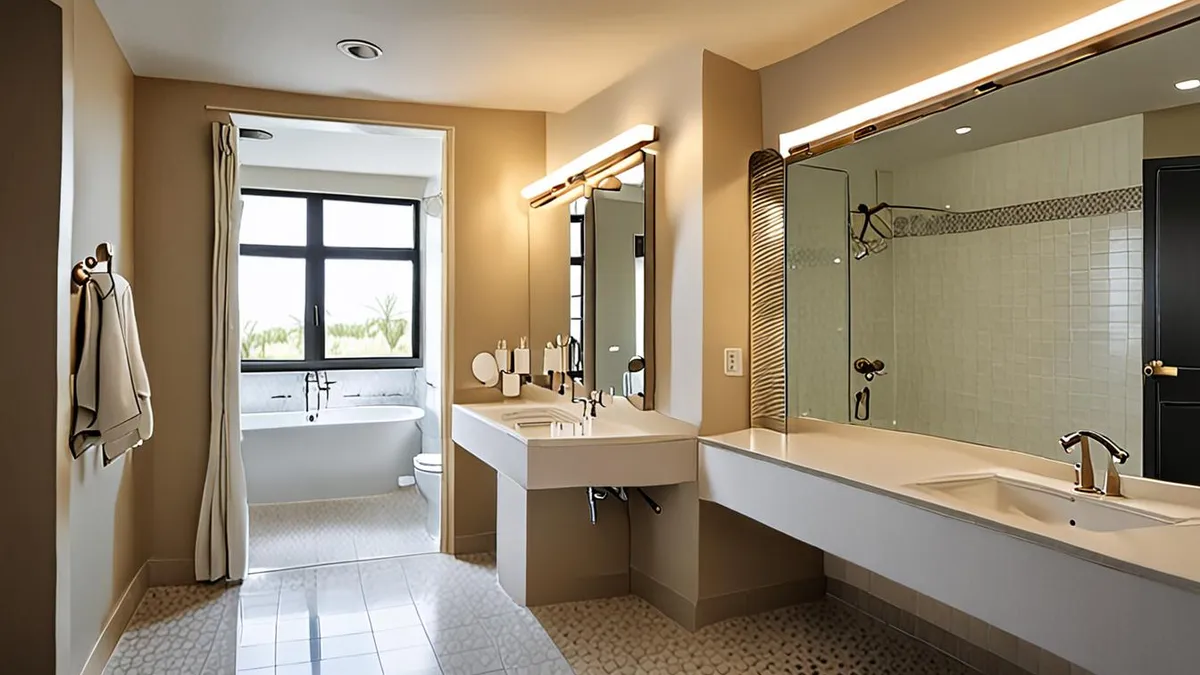
Specific measurements and fixtures make the difference between a room that works and one that does not. Doorways need a clear width of at least 32 inches (81 cm) to accommodate a standard wheelchair. In the bathroom, a roll-in shower with no lip at the base is the most requested accessible feature, ideally paired with grab bars near the toilet and inside the shower. Inside the room, look for lowered peepholes so a seated guest can see who is at the door, and light switches and thermostats placed at a reachable height.
The key lesson is to check at two levels. First, confirm the property itself is accessible: step-free entry, elevator access to your floor and corridors wide enough to maneuver. Second, confirm the specific room you are booking has the features you need. Hotels frequently advertise accessibility based on their lobby or a single adapted room, so never assume that “accessible hotel” automatically means “accessible room available for your dates.”
How to Search for Accessible Rooms on Booking Platforms
Booking platforms have made searching for accessible rooms easier, but their filters are a starting point rather than a guarantee. The information comes from hotels themselves and is not always verified, so treat every filter result as a lead that needs checking, not as confirmation that a property will work for you. Filters also tend to be broad: a hotel can tick an accessibility box while its only adapted room is already taken, or while the “accessible” label refers to the lobby rather than the rooms. Used carefully, though, filters are still the fastest way to cut a long list of options down to a realistic few. Here is a practical way to narrow your options.
- Apply the accessibility filters first. Major booking sites let you filter for wheelchair-friendly stays. This instantly removes properties that make no accessibility claims at all and saves you from checking dozens of unsuitable options one by one.
- Filter by specific features where available. Look for options such as “step-free access” and “roll-in shower” in the filter menu. These two features cover the most common dealbreakers: getting into the building and getting into the shower.
- Shortlist three to five properties. Don’t fixate on a single option. A shortlist gives you alternatives if your first choice turns out to have a step at the entrance or no adapted rooms left.
- Study the photos before contacting anyone. Zoom into bathroom photos to see the shower layout and whether there appears to be a lip at the base. Look at doorways, the elevator and the entrance in the images. Photos often reveal what text descriptions gloss over.
Once your shortlist is ready, you can move on to direct questions with the hotel, armed with what the photos already told you. This preparation makes your calls and emails shorter, more specific and much more likely to get useful answers. It also means you spend your time chasing genuinely promising properties instead of starting from scratch with every search result, which matters when adapted rooms are limited and the good ones go quickly.
Questions to Ask the Hotel Before You Book
This is the step most travelers skip, and it is where most disappointments originate. A front desk agent saying “yes, we have accessible rooms” tells you almost nothing. That phrase can describe anything from a fully adapted suite to a standard room with a grab bar bolted next to the toilet. The room could still have a raised shower lip, a door that is technically adapted but narrower than your chair, or grab bars positioned where they are of little use. The fix is simple: get specific, and get it in writing. Treat the call as an interview, not a courtesy check, and let the answers guide whether you book or keep looking.
- Ask for exact door width measurements. A vague “the doors are wide” is not an answer. Ask for the clear width in inches or centimeters and compare it to your wheelchair’s dimensions, including footrests. ADA-compliant doors need a clear width of at least 32 inches (81 cm), so that is a useful benchmark to measure any answer against.
- Get the shower described in detail. Ask directly whether the shower is a true roll-in with a flat entry or whether it has a raised lip, and how high that lip is if one exists. Roll-in showers are the most requested accessible bathroom feature, so hotels hear this question often and should be able to answer it quickly. Also confirm grab bars are installed in the shower and near the toilet.
- Ask about the bathroom layout. Confirm whether you can actually turn a wheelchair inside the bathroom, not just get through the door, and whether the sink and toilet are at usable heights for you. A bathroom you can enter but not move around in creates real problems on a multi-day stay.
- Request email confirmation. After the call, ask the hotel to email you a summary of what was confirmed. If something is wrong on arrival, that email is your proof and your basis for asking for a remedy, whether that is a different room or a resolution with management.
When the hotel hesitates to put specifics in writing, that hesitation is useful information in itself. A property confident in its accessibility features will usually have no trouble confirming measurements by email, often within a day. Staff who dodge the question, promise to “check and call back” repeatedly, or suggest you just see the room when you arrive are telling you something about how the property handles accessibility overall. In those cases, it is usually better to move on to another hotel on your shortlist than to gamble on a promise. And that written record protects you if you arrive to find something different from what was promised, because you can show it at the front desk instead of arguing from memory.
Booking Timing and Room Availability
Here’s the hard truth about accessible rooms: they are scarce, and scarcity drives everything about when and how you should book. Most hotels keep accessible rooms well under 5% of their total room count, which means a property with 200 rooms might have only a handful that actually work for a wheelchair user. Standard rooms can be released and resold freely, but once those few accessible rooms are gone, there is no upgrade option that solves your problem.
Because of this, accessible rooms typically sell out first, even at hotels that seem half-empty on booking sites. A property showing plenty of availability can still have zero accessible rooms left for your dates. Treat the room type itself as the thing that will disappear, not the hotel.
How far ahead should you book?
Booking 2-3 months ahead gives you the best chance of securing the exact room type you need, especially in peak season or in popular city centers. If your travel dates are fixed and non-negotiable, book even earlier and cancel later if plans change. For more general strategies on when to book and which tools help, see this guide to booking hotels for less.
The good news is on the price side. Accessible rooms generally cost the same as standard rooms in the same category, so you are not paying a premium for the room itself. If a hotel quotes more for an accessible room of an equivalent category, ask why, and be prepared to book elsewhere.
Accessibility Differences by Destination
Where you travel shapes how easy this whole process will be. Building codes, hotel age and local attitudes toward accessibility vary a lot between regions, so the same search strategy can produce very different results in New York, Rome or Kyoto.
The United States
Newer US hotels are the most predictable option for wheelchair users. Properties built or renovated in recent decades follow ADA standards, so accessible rooms typically come with doorways wide enough to meet the 32-inch (81 cm) minimum, roll-in showers in the bathrooms, and accessible routes through public areas. Large chain hotels in American cities are usually a safe shortlist starting point, though it still pays to confirm the room details directly with the property.
Europe
Europe is more of a mixed bag. Older European hotels, especially those in historic districts, often have narrow doorways and steps at the entrance that were never designed with wheelchairs in mind. A charming 18th-century townhouse hotel may have no elevator at all, or an elevator too small for a wheelchair. Newer properties on the outskirts of cities, or modern chains, tend to follow current accessibility rules and are far more reliable choices. When comparing European hotels, weight the building’s age heavily in your decision.
Japan
Accessibility in Japan is improving steadily, and modern city hotels generally offer good barrier-free rooms that can be requested at booking. The challenge is traditional accommodation: many ryokan remain step-heavy, with raised entrances, tatami flooring and bathrooms that are not designed for wheelchair use. If you are weighing a traditional stay against a standard one, read this comparison of a ryokan versus a hotel in Japan before deciding. For a first accessible trip to Japan, modern city hotels are the safer bet.
Verifying Everything Before Arrival
You’ve found a hotel, asked the right questions and received a promising answer. Don’t stop there. Details get lost between reservation systems, shift changes and third-party booking sites, and a verbal promise made months ago is not the same as a confirmed room next week. Front desk staff rotate, notes in reservation systems get truncated, and the person who promised you a roll-in shower may not be working the day you arrive. A short verification round before you travel protects everything you’ve worked for, and it costs you almost nothing in time or effort.
- Reconfirm 48-72 hours before arrival. Call or email the hotel in this window, which is standard practice, and ask them to verify that the accessible room specifically is reserved under your name. This catches the most common failure: the reservation exists, but the room type was quietly changed to a standard room.
- Walk through the arrival route in advance. Ask how you get from the parking garage or drop-off point to your room, and whether that route includes any steps, steep ramps or a secondary entrance. Knowing this ahead of time means no surprises when you arrive with your luggage.
- Get a name and keep the paper trail. Note the name of the staff member you spoke with and save every email confirmation in a folder you can reach offline. If something goes wrong at check-in, having a named contact and written proof of what was promised turns a frustrating argument into a simple, solvable conversation.
This final check takes fifteen minutes and can save your entire trip. Accessible rooms are typically under 5% of a hotel’s total room count, which means there is rarely a spare accessible room waiting if yours falls through, so treat the reconfirmation as part of packing, not as an optional extra. Put it in your calendar at the same time you book, alongside your email confirmations and any written promises about door widths or bathroom features. A traveler who arrives with written proof and a staff contact name is the one who gets the room they actually booked, while everyone else is left arguing at the front desk with nothing to show.
The Bottom Line on Finding Wheelchair-Friendly Rooms
Many travelers who end up stranded by an unexpected flight of stairs or a bathroom too narrow for a wheelchair made the same mistake: they trusted a listing instead of verifying the details. The fix comes down to three habits. Book early, because accessible rooms are typically under 5% of a hotel’s total room count and sell out first. Get written confirmation by email, so you have proof of exactly what was promised. And verify door widths and the bathroom layout directly with the hotel rather than relying on booking filters, which are only a starting point.
Destination matters too. Newer properties, especially those built to ADA standards, are far more predictable than historic buildings with narrow doorways and entrance steps. A little extra checking before you book turns an uncertain gamble into a trip you can actually relax about. Have you run into a hotel that looked accessible online but wasn’t? Share your experience in the comments, or pass this article along to someone planning their next trip.