You’re back at your hotel after a long day of sightseeing or meetings. You’re hungry, you’re thirsty, and the mini-bar is right there—along with a room service menu that looks tempting but suspiciously expensive. Is that $7 beer and $25 burger actually a rip-off, or sometimes a fair price for convenience? That’s the question most travelers face at least once per trip, usually while standing barefoot in front of a tiny fridge.
This guide breaks down hotel mini-bars and room service so you know exactly what you’re paying for before you lift that soda or dial the kitchen. We’ll look at typical mini-bar markups, how delivery fees and tips inflate a room service order, and the situations where ordering in is genuinely worth it. We’ll also cover cheaper in-room alternatives, nearby restaurants that often charge far less for similar meals, and how your hotel’s category changes the math—before wrapping up with a simple bottom line to guide your next late-night decision.
What Hotel Mini-Bars Really Cost
Hotel mini-bar prices are famously steep, and for good reason: you are paying for the convenience of having that drink three steps from your bed. As a general rule, mini-bar items run 2-4 times what the same drink or snack costs at a convenience store around the corner. That markup is how hotels cover the cost of stocking, restocking and monitoring hundreds of tiny fridges.
What You Can Expect to Pay
A soft drink from the mini-bar often runs $4-7, a beer typically lands in the $7-10 range, and a small snack such as a candy bar or bag of chips usually costs $3-6. Multiply that across a few nights of late-night snacking, and a modest mini-bar habit can quietly add $30-50 or more to your bill. The same haul from a corner store would usually cost a fraction of that.
There is also a trap many travelers don’t know about: many hotels restock mini-bars daily and bill automatically the moment an item is lifted or removed. Weight sensors and RFID tags mean you don’t have to actually consume anything to trigger a charge. Simply moving a bottle to make room for your own water bottle can register as a purchase.
Avoiding Surprise Charges
If you accidentally set off a sensor, don’t panic. Call the front desk or mention it at checkout, and most hotels will reverse an honest mistake without fuss. It also helps to check your final bill line by line before paying, since small mini-bar charges are among the most common hotel billing errors.
Room Service Pricing: Food, Fees and Tips
Room service menus look a lot like restaurant menus, but the prices tell a different story. A basic burger or plate of pasta usually costs $18-30 in mid-range and upscale hotels, well above what the same dish would set you back at a restaurant or diner at street level. You are paying for the convenience of having it brought to your door, and hotels price that convenience accordingly.
The menu price is rarely the final number, either. Most hotels add a delivery or tray fee, commonly $3-10 per order, which covers the cost of bringing food up and taking the tray away later. On top of that, a tip for the server is expected, and some hotels automatically add a service charge to the bill. Before you know it, a $20 burger can cost closer to $30 all in.
Breakfast is where markups bite hardest
If there is one meal where room service feels especially expensive, it is breakfast. A pot of coffee, juice, eggs and toast often carries the steepest markup of anything on the menu, sometimes costing double or more what the hotel charges for the identical items in its own restaurant, often just a floor or two below your room.
A practical habit is to compare the in-room dining menu against the restaurant menu at check-in, and ask whether you can take breakfast in the restaurant instead. Unless you specifically want to eat in your robe while answering emails, walking downstairs usually saves a meaningful amount, and the food often arrives hotter, too.
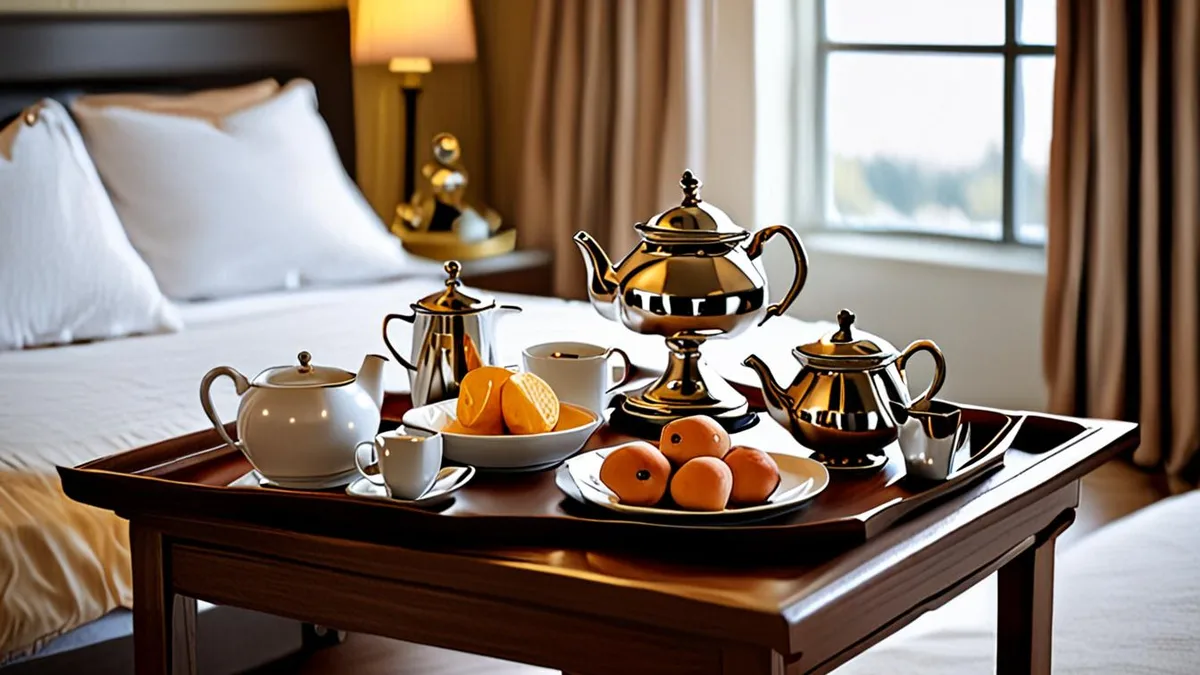
When Paying In-Room Is Actually Worth It
There are moments when the premium price of eating in your room stops feeling like a rip-off and starts feeling like a fair trade. Picture landing on a red-eye, checking in at 1 a.m., and realizing every restaurant within walking distance is closed. A $25 burger delivered to your door suddenly looks reasonable compared with wandering unfamiliar streets for 20 minutes, exhausted and hungry, only to end up paying for something anyway.
Jet lag works the same way. When your body thinks it’s 3 p.m. but the local clock reads midnight, dragging yourself out for food can wreck what’s left of your sleep. Bad weather is another honest trigger: if a tropical downpour is hammering the street outside your hotel, the convenience store run you’d normally make loses its appeal fast. In cases like these, the convenience fee is really buying back your time and comfort, and that can be money well spent.
Business travelers have an even simpler calculation. If your company covers meals on the road, ordering in while you finish a report or prep tomorrow’s meetings turns room service into a time-saving expense rather than a personal splurge. Just confirm your employer’s meal policy first so there are no surprises on the expense report.
Then there are the stays where the experience itself is the point. If you’re booking a honeymoon suite or celebrating an anniversary, in-room breakfast or a chilled bottle of champagne changes the math entirely. You’re not paying for food; you’re paying for the memory. Choosing where you stay matters here too — picking the right neighborhood, as we explain in our guide to the best areas to stay in Singapore, shapes how much you’ll even need in-room services.
- Compare the cost of your time. If a 20-minute search for an open restaurant ends with a taxi ride anyway, the room service premium may cost less than the detour in fares and lost sleep.
- Order strategically on business trips. A quiet dinner in your room while reviewing notes can replace a rushed restaurant meal, and billing it to the company keeps your own budget untouched.
- Make the splurge part of the celebration. Pre-arranging in-room champagne or breakfast for a special morning often feels more personal than a restaurant table, and the markup is easier to accept when it’s a once-a-year treat.
- Pick one indulgence per stay. If you love the ritual of in-room breakfast but balk at dinner markups, order breakfast in and eat your other meals out nearby — you get the experience without the full premium every day.
Cheaper Alternatives to the Mini-Bar
The easiest way to beat mini-bar pricing is simple: don’t use the mini-bar. In most cities, you’ll find a convenience store or small supermarket within a 5-15 minute walk of your hotel. Buy your drinks and snacks there, bring them back to your room, and you’ll pay a fraction of the in-room price for exactly the same items.
Before you stock up, ask a few questions at check-in. Front desk staff can usually tell you right away whether the hotel offers free bottled water, whether your room has a working coffee machine, and whether there’s a hospitality fridge you’re allowed to use for your own purchases. Many hotels provide these perks, but they don’t always advertise them clearly.
One caution before you start rearranging the fridge: many modern mini-bars are sensor-based, weighing or scanning each slot and billing automatically when an item is lifted. If that’s the setup in your room, don’t move items around or squeeze your own food in among them unless staff confirm it’s fine. A false charge is easy to trigger and annoying to dispute at checkout.
- Shop on arrival day, not midnight. Convenience stores near tourist areas often close earlier than you’d expect, so pick up supplies when you check in rather than when the craving hits.
- Check whether your room has a kettle or ice bucket. Either one lets you chill bottled drinks from the store without touching the mini-bar fridge at all.
- Photograph the mini-bar when you arrive. A quick photo of the shelf layout and any seals gives you proof if a sensor charge appears on your bill for something you never touched.
- Ask about an empty fridge on request. Some hotels will unplug or empty the mini-bar for your stay if you ask, which frees up space for your own snacks without billing risk.
Eating Out Nearby Instead of Ordering In
Room service feels effortless until the bill arrives, and that’s when a short walk starts looking very attractive. Restaurants just outside your hotel doors routinely charge noticeably less for dishes similar to what’s on the in-room menu, and the food is often better too, since it comes from a kitchen that specializes in it rather than a hotel pantry built for convenience.
Even if you’re tired and don’t feel like leaving the building, you have a middle option. Food delivery apps frequently undercut hotel room service even after you add the delivery fee and tip, especially for casual food like burgers, pizza, noodles or sandwiches. The hotel’s version of the same meal carries a premium partly because you’re paying for the tray, the runner and the kitchen’s overhead.
When the walk is worth it
Think of it this way: skipping one in-room dinner can free up enough money to cover dessert, a drink or even another meal the next day. You also get a feel for the neighborhood around your hotel, which is half the reason you traveled in the first place. Ask the front desk where locals actually eat, not just which places they recommend to guests.
Choose your hotel location wisely
If you haven’t booked yet, factor dining into the decision. A hotel near a dining street, a night market or a cluster of restaurants makes cheap meals the default choice. When good food is literally around the corner, the temptation to order an expensive in-room burger at midnight mostly disappears. Location does more to protect your food budget than any amount of willpower, so check the map before you check the rate.
How Hotel Category Changes the Value
Not all mini-bar and room service markups should be judged the same way, because the value of what you’re paying for depends heavily on the category of hotel you’ve booked. A charge that feels like a rip-off at one property can feel like good value at another, even for the identical soda or sandwich.
Luxury hotels: expensive, but part of the package
At luxury and five-star properties, in-room prices are undeniably high, but the service quality is part of what you already paid for. The burger arrives exactly as you ordered it, at the time you requested, delivered by someone who sets it out properly and returns to clear the tray. If you’ve booked that level of hotel, using room service occasionally is simply using the product you chose. If you’re unsure how these categories work, it helps to understand what hotel star ratings actually measure before you book.
Mid-range and budget hotels: the steepest markups
This is where in-room pricing stings the most. In mid-range and budget hotels, the same soft drink, beer or snack is usually available cheap just outside the door, often at a store within a few minutes’ walk. Paying several times the street price for the convenience of a few steps feels hardest here, because the service around it rarely adds much beyond the delivery itself.
There’s a pleasant exception to watch for: some boutique hotels now offer free minibars or honor bars, where soft drinks and snacks are included in your rate or operate on an honesty system. It’s a genuine perk, and one worth checking when you’re comparing rates between similar properties. Two hotels at the same nightly price can end up costing very different amounts once you factor in what each one charges for a bottle of water at midnight.
The Bottom Line on Mini-Bars and Room Service
So, are the mini-bar and room service worth it? The honest answer is that they usually aren’t, at least not on price alone. Mini-bar items typically run 2-4 times what you’d pay at a nearby store, and a basic room service meal of $18-30 often comes with another $3-10 in delivery or tray fees before you even add a tip. That late-night burger can easily cost triple the street price.
That said, the splurge makes sense in certain moments: late arrivals when nothing else is open, bad weather, business stays where time matters more than money, and special occasions where the experience itself is the point. For everything else, nearby shops, delivery apps and restaurants a short walk away deliver the same food and drinks for far less. If this helped you decide, leave a comment or share the article with a fellow traveler.