Many first-time safari guests spend their trip torn between excitement and worry. You may sit in an open vehicle just meters from a lion and wonder: is this actually safe? The truth is that safari lodge safety rests on a small set of clear rules, most of which are simpler than travelers expect. Once you understand them, you can relax and enjoy the wildlife instead of second-guessing every moment.
This guide walks you through the whole system, from the moment you meet your guide to the walk back to your tent after dinner. We cover why safari lodge safety starts with your guide, the rules on the game drive vehicle, wildlife etiquette that protects animals and guests, staying safe inside camp after dark, walking safari and family rules, and how to choose a lodge with strong safety standards. By the end, you will know exactly what is expected of you and why it matters.
Why Safari Lodge Safety Starts With Your Guide
Every good safari starts with the person behind the wheel. Guides at reputable lodges hold recognized field guiding qualifications and typically complete two to four years of apprenticeship before they are allowed to lead drives on their own. That training covers animal behavior, tracking, vehicle handling, first aid and radio procedures. In other words, the guide deciding where to park next to a leopard has spent years learning exactly that skill.
Guides do more than find animals. They read behavior constantly: the flick of an elephant’s ears, the way a lioness turns her head, the tension in a buffalo herd. From those signals they decide whether the vehicle may move closer, hold position or back away. That judgment call belongs to the guide alone, not to the guest with the longest lens.
What your tracker does
Many lodges also carry a tracker, seated at the front of the vehicle. The tracker reads tracks, broken branches and bird calls, spots animals long before you do, and watches for hazards such as hidden buffalo or soft ground. The guide drives and manages the sighting while the tracker scans the bush, which is a two-person safety system.
The practical takeaway is simple: follow your guide’s instructions instantly, even when they cut a sighting short or move the vehicle when you wanted one more photo. Their instructions override guest preferences every time, because they are based on what the animals are doing, not on what looks good in a picture.
Rules on the Game Drive Vehicle
The game drive vehicle is your safe zone, but only if you treat it that way. Animals generally see the vehicle as one large shape, not as individual people. The moment you stand up, lean out or dangle an arm over the side, you break that illusion and change how the animals perceive you. Stay seated for the entire drive and keep arms, hands and cameras inside the vehicle at all times, even when the sighting feels calm.
Voice control matters just as much. Keep conversations low, and never shout to point out an animal. Sudden noise can startle wildlife, scatter a sighting in seconds and spoil the moment for every other vehicle in the area. Most lodges also brief guests on these rules within the first hour of arrival, so listen carefully at check-in.
- Distance rules exist for a reason. In most reserves, vehicles keep at least 25 meters from large predators and 25-30 meters from elephants, and they never position themselves between a mother and her young, the single most dangerous place to be.
- Timing follows animal activity. Typical drives run at dawn, around 5:30-6:30 am, and in the late afternoon, around 3:30-4:30 pm, when predators hunt and animals move to drink. Midday drives are shorter and quieter by design.
- Seatbelts and rough tracks. Drives cross bumpy terrain, so keep your seatbelt fastened where fitted and stow loose gear under your seat rather than on your lap.
If you feel uncomfortable at any point, tell your guide calmly and quietly. They can adjust the vehicle’s position without disrupting the sighting.
Wildlife Etiquette That Protects Animals and Guests
Good wildlife etiquette is not just politeness; it directly affects how safe a sighting is for everyone. The most common mistake new guests make is pushing for a better view: calling out, clapping, or asking the guide to get closer for a photo. Never do this. Your guide decides the distance based on animal behavior, and pressure from guests is exactly what leads to risky positioning.
Etiquette also extends to how long you stay. Give animals right of way, and limit your time at a sighting so other vehicles can rotate in. Crowding an animal with several vehicles for half an hour stresses it and often causes it to move off entirely, ending the sighting for everyone. A few minutes of patient watching usually rewards you with better behavior than a long, noisy stay.
- Never feed any animal. This includes the birds around breakfast and the monkeys that loiter near camp. Fed animals lose their fear of people, become bold and sometimes aggressive, and often have to be relocated or destroyed.
- Think about scent and color. Avoid strong perfumes and bright colors on guided walks; neutral, earth-toned clothing is the standard because it keeps you visually unremarkable to wildlife.
- Keep noise discipline off the vehicle too. Loud music or conversation around camp carries into the bush and disturbs animals near the waterholes.
Treat every animal as wild, every moment as temporary and every instruction from staff as final. That mindset keeps both you and the wildlife safe.
Staying Safe Inside the Camp After Dark
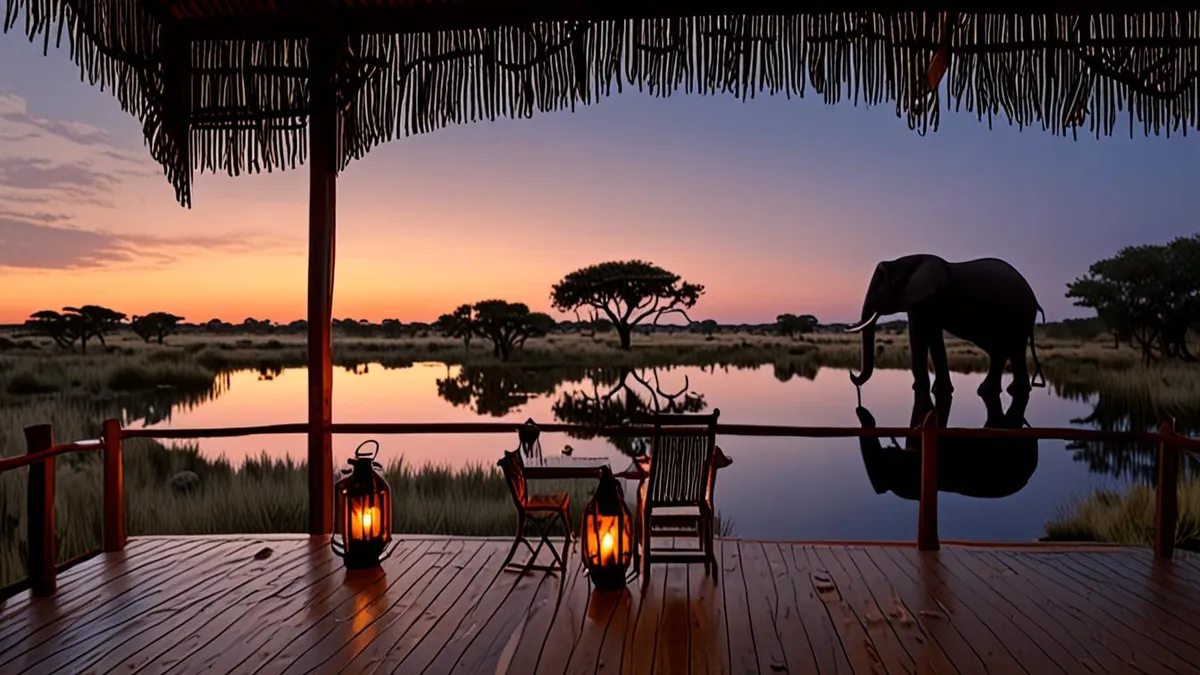
Many safari camps are unfenced or only partially fenced, which means elephants, hippos, buffalo and even predators can wander through camp, especially after sunset. This is not a reason to worry, but it is a reason to change your habits the moment the light fades. Animals that seem relaxed during the day behave very differently at night.
After dark, guests stay within camp and staff escort you between your tent and the main lodge. This is standard procedure at well-run lodges, not a formality. If you hear a knock or a radio call at night, wait for the escort rather than stepping outside on your own, even for a short walk to the dining area.
Inside Your Tent
Keep tent zips fully closed from dusk until morning, and store food, toiletries and luggage securely. Scented lotions and snacks can attract baboons, monkeys and honey badgers, and a bag rummaged through overnight is a common safari mishap. If your tent has a torch or radio for emergencies, keep it where you can reach it in the dark.
Timing matters too. During the dry season (June-October in East Africa, May-September in Kruger) animals concentrate around waterholes, and camps built near water see noticeably more nighttime visitors. If you are still choosing where to stay, this guide to choosing a safari lodge in Kruger by area and season explains how location affects what you will experience.
Walking Safaris and Family Safety Rules
Walking safaris are a completely different experience from a game drive, and the safety rules reflect that. You are on foot, at animal level, led by an armed guide who sets the pace and the route. Because of the risks involved, walks are typically restricted to guests aged 12-16 and older, depending on the reserve and the operator.
Listen carefully to the pre-walk briefing and follow it exactly. Walk in single file behind the guide, stay silent when instructed, and never wander off to photograph something on your own. The guide decides when to stop, when to freeze and when to back away, and those decisions happen in seconds.
Families should do some homework before booking rather than assuming a lodge will work for kids of any age. Minimum ages often differ for game drives, walking safaris and stays in unfenced camps, so confirm each one directly with the lodge. Our article on choosing a family lodge covers what to look for in more detail.
- Waterhole supervision: keep children within arm’s reach near camp waterholes, where animals come to drink and crocodiles may be present.
- Escort rule for kids: children should never move between tents or to the pool after dark without a staff escort and a parent.
- Age verification: some reserves ask for proof of age at check-in for walks, so bring identification for younger travelers.
- Quiet practice: prepare young children for the silence required on walks before you arrive, since a sudden shout can end a sighting.
How to Pick a Lodge With Strong Safety Standards
The best predictor of a safe safari is the lodge itself, so it pays to ask a few direct questions before you book. Start with the camp layout: is it fenced or unfenced, and what is the night escort policy? A reputable lodge will answer clearly and explain how guests move around after dark.
Questions to Ask Before Booking
Ask about guide certification and how many staff ride along on each drive. A good ratio means a driver, a guide or a tracker plus a spotter, which improves both safety and sighting quality. Also confirm the medical emergency plan: how the lodge handles injuries or illness, and roughly how far the nearest clinic or airstrip is.
Guest reviews are useful here, but read them with a filter. Look for recent comments that specifically mention guide professionalism, safety briefings and how staff handled a close wildlife encounter, not just the food and the views. Patterns in reviews tell you more than a single glowing comment.
Finally, remember that safety standards exist at every price point. If you are weighing options, this breakdown of budget, mid-range and luxury safari lodges shows what to expect at each tier, so you can match your budget to the safety features you are not willing to compromise on.
Wrapping Up: Safe Safari Habits to Remember
Being close to wild animals on safari can feel intimidating at first, but the rules that keep you safe are simple and consistent. Trust your guide and follow their instructions on every drive and walk, since their experience is what makes those close encounters safe. Keep a respectful distance of around 25 m from large animals, and never feed anything, from elephants to the monkeys that wander through camp.
Once night falls, let staff accompany you whenever you move around camp, keep your tent zipped, and store food properly. Before you book, choose a lodge with clear safety standards, from guide qualifications to night escort policies. Follow these habits and your safari will be memorable for all the right reasons. If you found this helpful, leave a comment or share it with a fellow traveler planning their first safari.