You’re at booking checkout, mouse hovering over the breakfast add-on. It’s $22 per person per night, and you genuinely can’t tell if that’s a smart buy or an expensive habit you’ll regret by day three. Hotel breakfast pricing is confusing on purpose: some rates include it “free,” some charge eye-watering buffet fees, and some hotels sit next to a perfect bakery that costs a fraction of the price.
This guide breaks the decision down with real numbers. We’ll explain what “breakfast included” actually means at different hotels and chains, what paid buffets cost around the world, and how to compare a breakfast-included rate against a room-only rate at the same property. We’ll also cover when skipping the hotel breakfast makes sense, how to decide before you book, how the math changes by trip type, and a final bottom line to run before checkout.
When Hotel Breakfast Is Actually Included (and What That Really Means)
“Breakfast included” is one of the vaguest phrases in hotel booking, and it can mean very different things depending on where you stay. Before you assume you’ve scored a deal, it helps to know what each type of inclusion actually puts on your plate.
What “continental” really means
A continental included breakfast usually means pastries, bread, coffee and juice — not a hot buffet with eggs, bacon and made-to-order dishes. At many budget European hotels, that’s the entire offer: a roll, a croissant, and a machine-brewed coffee. It’s fine if you eat light, but if you were picturing a full spread, you may be disappointed. Always read the fine print or check recent reviews to see what the included breakfast actually looks like.
Where full buffets come standard
Full buffet inclusion is most common in Asia and the Middle East, where even mid-range properties frequently bundle a generous hot-and-cold buffet into the room rate. It’s rare at budget European hotels, where breakfast is more often a paid extra or a minimal continental offering. If a full buffet matters to you, destinations in Asia and the Middle East are where inclusion works in your favor.
There are two more checks worth making before you book. First, loyalty status and booking direct often add breakfast free at mid-range and upscale chains, so compare the direct rate against the cheapest third-party rate before paying for breakfast separately. Second, and most importantly: always check whether “breakfast included” covers all guests or only one person in the room. Some rates include breakfast for a single guest, leaving a partner to pay the full walk-in price — a surprise that can wipe out the apparent saving.
What Paid Hotel Breakfast Costs Around the World
If breakfast isn’t included, the walk-in buffet price can sting. In Europe, expect roughly $15–35 per person for a hotel buffet breakfast, while in the US and the Middle East the typical range is higher, around $20–45 per person. These are prices for what’s often a standard hot buffet, not anything especially elaborate — which is exactly why so many travelers wonder whether it’s worth it.
Asia flips the value equation. Buffets there, especially in Japan, often deliver the best value at $10–20 per person, and quality is frequently excellent: fresh rice dishes, miso soup, eggs, pastries and fruit on the same spread. At the other end of the scale, resort breakfasts can exceed $40 per person, stacking on top of other mandatory add-ons like resort fees and taxes. A family of four at a resort can easily spend more on one morning’s breakfast than on a nice dinner elsewhere.
Before you commit, keep these pricing realities in mind:
- Prices are per person, not per room. A rate that sounds like $25 for breakfast usually means $25 for each guest, so a couple pays double.
- Children’s pricing varies widely. Some hotels charge a reduced rate for kids, others charge full price from a certain age — ask before booking rather than at the buffet entrance.
- Walk-in rates can beat booking add-ons. Some hotels offer cheaper day-of breakfast rates at the front desk than the price bundled into your reservation, so it can pay to wait and ask at check-in.
- Resort pricing compounds. At isolated properties, the breakfast price is rarely the only mandatory extra, so budget for the total rather than the buffet alone.
To see how quickly this adds up: prices are usually per person, so a couple paying $25 each adds roughly $350 over 7 nights. That’s real money — enough to fund several excellent meals out, which is exactly the comparison the next section makes.
The Math: Breakfast Included vs Room-Only Rates
The cleanest way to decide is to compare two rates at the same hotel: the room-only rate and the breakfast-included rate. Breakfast-included rates typically run $10–30 more per night than room-only at the same property. That difference is your real price for breakfast — often far below the walk-in buffet price, which is why the included rate can be a genuine bargain. It also matters when comparing seasons: a rate difference that looks small in low season can look different during peak months, so check how European hotel prices shift by season before locking in either option.
A worked example
Imagine breakfast at the hotel would cost each person the standard walk-in price. If the breakfast-included rate is only $20 more per night than the room-only rate, two guests get double that walk-in value for a single $20 premium — a clear saving. But a solo traveler gets just one breakfast for that same $20, a much thinner margin that can flip negative if the rate premium creeps toward the top of the usual range. The number of guests in your room changes the math completely, so always run the comparison for your actual party size.
Match the math to your mornings
The rate difference only pays off if you actually eat at the hotel. Compare the nightly premium against how many mornings you will realistically eat there — not how many mornings you’re booked. If you have three early tours and four lazy days when you’d rather wander to a café, you’re only using the buffet three times. Heavy eaters and early starters get the most value from an included buffet: a big hot meal before a 7 am departure is hard to replace. Light coffee drinkers rarely break even — if your breakfast is a coffee and maybe a pastry, a nearby café will almost certainly beat the nightly premium.
When Skipping Hotel Breakfast Makes Sense
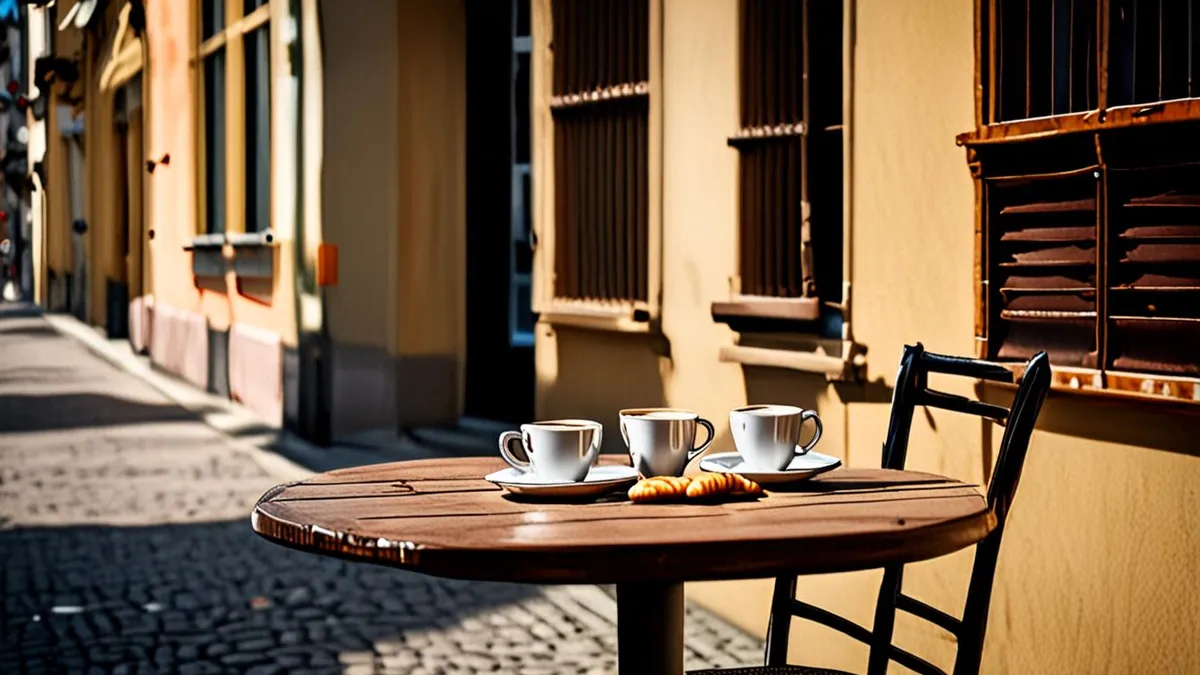
Some of the best breakfasts I’ve had on trips cost less than a bottle of water at the hotel bar. Step out of a city-center hotel in Lisbon, Paris or Vienna, and you’ll usually find a bakery or café within a few minutes’ walk, many of them opening their doors around 7 am. A fresh croissant and a coffee at the counter often costs a fraction of what the hotel charges for its buffet.
Across most European cities, a café or street bakery breakfast typically runs $3–8 per person. Compare that with the hotel buffet price you’ve been quoted at check-in, and the gap is hard to ignore. Over a week, a couple who skips the hotel breakfast can easily save enough to cover a nice dinner or a museum pass.
Where skipping works best (and worst)
Skipping works brilliantly in walkable European cities, where competition between bakeries keeps quality high and prices low. It works worst at isolated resorts, where the nearest café might be a taxi ride away and the hotel knows it has you captive. If your only alternative is the resort buffet or nothing, paying for breakfast suddenly looks reasonable.
There’s a second way to stretch the saving: buy extra at the bakery. A loaf of bread, some cheese and fruit from a morning market doubles as a cheap picnic lunch later. That turns one bakery stop into two meals, which is exactly how many locals and savvy travelers do it.
How to Decide Before You Book
Deciding between a breakfast-included rate and room-only doesn’t require a spreadsheet, but it does require ten minutes of checking before you click “book.” A few simple steps will tell you whether that rate premium is money well spent or money thrown away.
- Check the neighborhood. Look at a map around the hotel and see what opens nearby in the morning. If cafés and bakeries start serving at 7 am within a short walk, room-only is usually the better deal, because you can eat well for a few dollars instead of $15–35.
- Read recent reviews for breakfast quality. Search the reviews for the word “breakfast” and sort by the most recent. A $30 buffet with cold eggs and stale pastries is poor value at any price, while a genuinely good spread can justify the premium.
- Factor in your schedule. If you have an early tour, a sunrise hike or a morning flight, the hotel buffet may be the only thing serving at 6 am. In that case, paying for convenience is often worth it, even if the food is average.
- Ask about breakfast packages at check-in. Front desk staff sometimes have flexibility on morning meal pricing that the booking engine doesn’t show, especially if the dining room looks half empty. It costs nothing to ask, and the answer sometimes changes your math on the spot.
It also helps to think about who is traveling with you. A couple eating the buffet every morning can rack up a surprising total over a week, so multiply the per-person price by the number of mornings you’ll actually be there. Solo travelers with light appetites often come out ahead with room-only and a pastry from the bakery next door.
None of these steps takes long, and together they cover the three things that actually matter: where you are, what the food is like, and when you need to eat. Run through them before you book, and you’ll rarely overpay for breakfast again.
Hotel Breakfast by Trip Type: City Breaks, Resorts and Japan
The right breakfast strategy depends heavily on what kind of trip you’re taking. A rule that saves you money in Barcelona can cost you money in the Maldives, so it helps to think in terms of trip types rather than one-size-fits-all advice.
City breaks favor skipping. In most European cities, independent bakeries and cafés open early and charge a fraction of the hotel buffet price, often with better pastries and better coffee. You also get a front-row seat to local morning life, which is half the reason you came to the city in the first place. If your hotel sits on a quiet street with a bakery around the corner, the room-only rate usually wins.
Resort stays are the opposite. Remote locations leave you with few alternatives, so the hotel effectively controls the breakfast market. In that case, a breakfast-included rate is often the sensible choice, because the alternative is paying full buffet price every morning with nowhere else to go.
Japan deserves its own category. Hotel breakfasts there frequently rank among the best value in the world, with fresh fish, miso soup, rice and pickles alongside Western options. Even in cities full of cafés, the hotel breakfast is usually worth adding.
- Japanese buffet variety: Many city hotels offer both Japanese and Western stations in the same buffet, so two travelers with different tastes can eat side by side without compromise.
- Ryokan meals are different: A stay at a ryokan, Japan’s traditional inn, typically bundles an elaborate multi-course breakfast into the room rate, so you’re not choosing whether to pay for it at all.
- Timing matters in Japan too: If you’re catching an early shinkansen or joining a day tour, the hotel breakfast’s early start time can make it the practical choice regardless of price.
The pattern is simple: the more walkable your location and the cheaper the local cafés, the more skipping makes sense. The more isolated the hotel and the better the included spread, the more the breakfast-included rate earns its keep.
The Bottom Line on Paying for Hotel Breakfast
So, does the breakfast add-on actually pay off? It comes down to simple arithmetic. Included breakfast wins when the rate premium of $10–30 per night is less than what you would otherwise spend eating out. Paid buffets at $15–45 per person only make sense for early starts, resort stays or genuinely exceptional quality. Skipping saves the most in walkable cities, where cafés serve breakfast from 7 am for $3–8 per person.
The right answer depends on your location, your schedule and your appetite, so run the numbers before you hit checkout. A couple paying $25 each per day adds roughly $350 to a 7-night stay, which is real money worth a second look. Do the math, book accordingly and enjoy that first coffee of the day wherever it costs you least. If this guide helped you decide, leave a comment or share it with a fellow traveler.