You found a beach resort deal that looks too good to be true — overwater views, a fraction of the usual rate, and one catch: the dates fall right inside hurricane season. That scenario is exactly what hurricane season resorts are about, and the trade-off is real. Deep discounts come with genuine disruption risk, from canceled flights to closed beach facilities.
This guide walks you through what you need to know before booking a Caribbean stay between June and November. We cover when hurricane season actually peaks and which regions face the highest risk, why resort prices drop so sharply, and how to protect your booking with refundable rates and insurance. You’ll also get a realistic picture of what a storm-disrupted stay looks like, plus lower-risk alternatives — from islands just outside the hurricane belt to destinations like the Maldives and Bali — so you can decide whether the savings are worth it for your trip.
When Is Hurricane Season and Where Are the Risks Highest?
The Atlantic hurricane season runs from June 1 to November 30, and it is not evenly spread across those six months. Activity builds through early August, peaks from mid-August through late October, and tapers off in November. September is statistically the most active month for Atlantic storms, so if you want the lowest odds of disruption, that is the window to be most cautious about booking.
Where you travel matters just as much as when. The western Caribbean, the Gulf of Mexico and the US Southeast coast historically face more direct-hit risk than the eastern Caribbean. Storms often form near Africa, track west across the basin, and strengthen as they approach the islands and coastlines on the western side. That said, geography is only a general guide, not a guarantee.
Storm tracks shift every year
One of the most important things to understand is that storm tracks vary year to year. An island that escaped untouched last season can take a direct hit the next one, and vice versa. There is no truly “safe” island during hurricane season — only places with lower historical odds. Check current forecasts from official sources like the National Hurricane Center close to your travel dates, and build flexibility into your plans rather than assuming history will repeat itself.
Why Hurricane Season Resort Prices Drop So Much
The biggest reason travelers consider hurricane season resorts at all is the price. Caribbean resort rates in peak storm months can fall 30-50% below high-season prices, which turns a luxury property into something many travelers can actually afford. The same oceanfront suite that costs a small fortune in February might be within reach in September.
Resorts know the discount alone is not always enough, so many add value extras to fill low-season inventory. Common perks include complimentary room upgrades, resort credits for dining and spa treatments, or free nights added to longer stays. These offers change by property and season, so compare what is actually included before booking.
The discount exists for a reason
Lower prices reflect real risk, not just lower demand. Cancellations, temporary closures and disrupted flights are all possible during the peak months, and a storm can undo the savings of a cheap rate in a single day. If you are tempted by the deals, it helps to understand the broader pricing patterns first — our guide to the best time to book Caribbean resorts for lower rates breaks down how rates move through the year.
If you want a middle path, target the shoulder months. Early June and late November still offer meaningful discounts, but the storm odds are noticeably lower than in the September-to-October peak. You trade some savings for considerably more peace of mind, which many travelers find is the sweet spot.
How to Book Hurricane Season Resorts Safely
Booking a resort during hurricane season is not reckless if you do it with the right protections in place. The goal is simple: make sure that if a storm disrupts your trip, you lose as little money and time as possible. Storms are unpredictable from one season to the next, so the smartest approach is to assume disruption is possible and build your booking around that assumption. Follow these steps before you confirm anything.
- Choose a refundable or free-cancellation rate. This is the standard hedge for any stay between June and November. Nonrefundable rates are cheaper, but one named storm can wipe out that saving entirely. Check the cancellation deadline carefully — some “free cancellation” rates still require notice several days in advance, which may be too late if a storm forms quickly.
- Buy travel insurance with hurricane coverage. Policies that cover hurricane-related cancellations and interruptions typically run 4-8% of the total trip cost. Read the policy details: coverage usually kicks in for named storms, and timing matters, so buy it soon after booking rather than waiting until a storm is already in the forecast — at that point it is generally too late to be covered.
- Check the resort’s hurricane policy before booking. Rebooking guarantees and closure compensation differ widely between properties. Some resorts let you reschedule for free if a storm forces closure; others offer little beyond what the law requires. Ask directly, get the answer in writing, and keep it with your booking confirmation.
- Book flights that allow free changes. Airlines issue waivers only when a named storm threatens an airport, and those waivers typically cover a limited window. A flexible fare lets you move before the waiver window opens, which can mean the difference between flying out early and waiting days for the next available seat.
None of these steps removes the risk of a storm — nothing can. What they do is shift the financial risk away from you and give you options when things go wrong. Think of it as a layered approach: the refundable rate protects your accommodation money, the insurance covers the broader trip costs, and the flexible fare protects your ability to actually get there or get home. Combined, these protections turn a gamble into a calculated, manageable booking, letting you enjoy the lower prices of hurricane season without losing sleep over the forecast.
What a Storm-Disrupted Resort Stay Actually Looks Like
Many travelers imagine that a hurricane only matters if it makes a direct hit on their resort. In reality, a tropical storm passing hundreds of miles offshore can still dump days of rain on your vacation, whip up rough seas, and keep you off the beach. The sky turns gray, the pool deck empties, and your sunset photos turn into shots of churning surf.
Resorts have well-rehearsed storm protocols, and you will notice them. Water sports get suspended first, since dive boats and jet skis are the first things a marina pulls when seas build. Beach facilities may close, and if a stronger system approaches, some properties move guests to inland buildings or partner hotels on higher ground. It is handled professionally, but it changes the character of your stay.
Getting out is its own challenge. Airlines typically cancel flights 24-48 hours before a named storm arrives, and airports in the storm’s path can stay closed for days afterward while runways, fuel supplies and staffing recover. That is why rebooking flexibility matters so much when you fly into the Caribbean during hurricane season.
Once a storm passes, the disruption does not always end immediately. Strong systems can knock out power and water across whole islands, and some smaller Caribbean properties take days or longer to restore full services.
- Storm prep takes over the resort routine: staff tape windows, stack lounge chairs indoors, and pull umbrellas and sunbeds from the beach, so even a near miss feels like a different hotel experience.
- Restaurants may run limited menus: deliveries stop when ports and roads close, so resorts often shift to simplified menus or set dinners until supply lines recover.
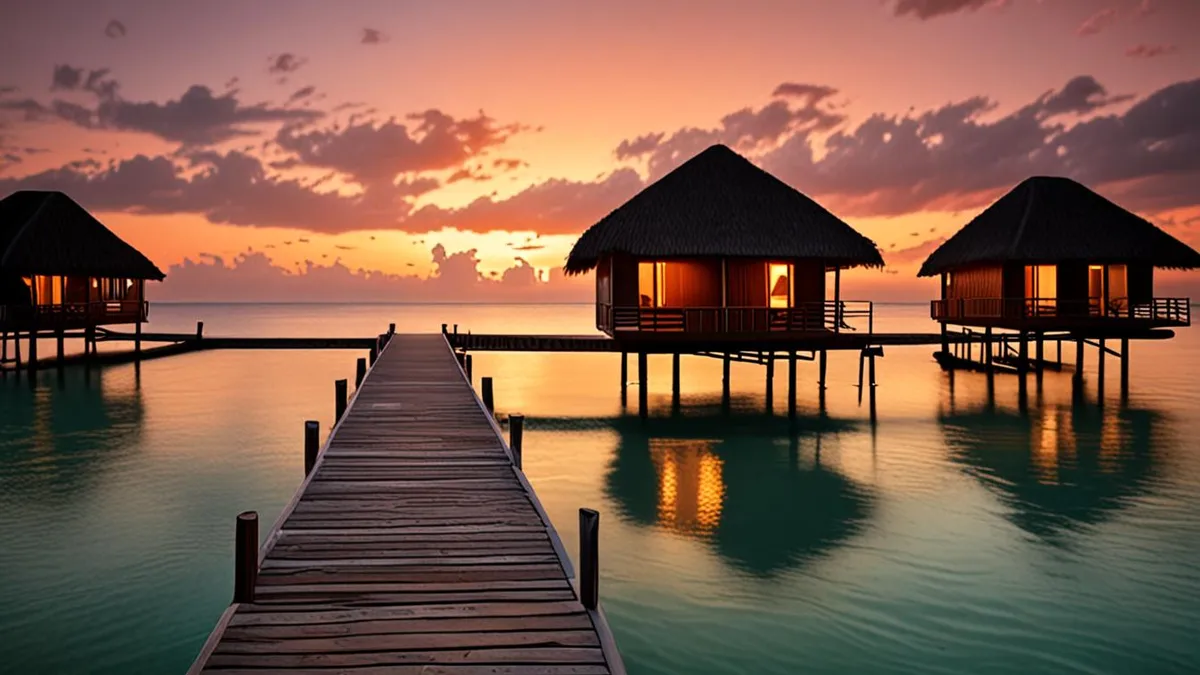
- Overwater accommodations close first: if you booked one of those dramatic overwater bungalows, expect it to be evacuated well before a storm arrives, since lagoon structures are the most exposed rooms on the property — this comparison of overwater bungalows vs beach villas explains what each option really delivers.
- Evacuation logistics vary by island: smaller islands with limited flights can fill up fast when everyone tries to leave at once, so guests who move early usually travel on better terms than those who wait.
Hurricane-Free Alternatives Outside the Atlantic
If you want warm-water beach weather during the Atlantic’s riskiest months, you do not have to gamble on a storm. Some of the world’s best resort destinations sit entirely outside Atlantic hurricane tracks, and they have their own weather rhythms instead.
The Maldives is the clearest example. This Indian Ocean nation lies far from any Atlantic storm path, so hurricanes are not part of the planning equation. What you do need to understand is the southwest monsoon, which typically runs from around May to October and brings more cloud cover, wind and rain showers. Resorts stay open and prices can be attractive, but you should pick your weeks with the monsoon in mind rather than against it. If you are weighing room types for a monsoon-month trip, this breakdown of Maldives overwater versus beach villa costs by season shows how the trade-offs shift.
Thailand works the same way. The Andaman coast, home to Phuket, Krabi and Ko Lanta, has no hurricane season at all — it has a monsoon season, with heavy seas and rain during its wet months. Beaches can close for swimming when the surf is rough, so check conditions for your specific travel window.
Bali and the wider Indonesian archipelago also sit outside hurricane belts year-round. Their wet and dry seasons follow tropical monsoon patterns, not Atlantic storm cycles.
- Rain seasons are usually shorter and more predictable: monsoon rain often arrives in intense bursts followed by sunshine, rather than the multi-day overcast stretches a nearby tropical storm can produce.
- Sea conditions matter as much as rainfall: during Andaman coast monsoon months, red flags and swimming bans are common even on dry mornings, so surf-loving travelers should time their trip carefully.
- Resort operations continue through the wet season: unlike a Caribbean property bracing for a named storm, Maldives and Bali resorts plan their maintenance and renovation schedules around predictable monsoon months rather than emergency closures.
- Flight reliability is a real advantage: with no storms to dodge, your long-haul flights into Malé, Phuket or Denpasar face none of the cascade cancellations that Atlantic hurricane season can trigger.
Choosing the Right Region Within Hurricane Zones
If your heart is set on the Caribbean, the good news is that hurricane risk is not spread evenly across the region. Where you book matters almost as much as when you book.
Start with the southern edge of the map. Aruba, Bonaire and Curaçao — the so-called ABC islands — sit south of the main hurricane belt, off the coast of Venezuela. Storms do occasionally affect them, but the odds of a direct strike are far lower than on islands farther north, and these islands market themselves partly on that reputation.
East versus west
History matters too. The eastern Caribbean islands, such as those in the Lesser Antilles, have historically seen fewer direct hits than the western Caribbean and the Gulf coast, where warm water and favorable steering currents give storms more room to intensify and track toward land. A resort on the western Caribbean or Gulf side of Mexico simply faces more direct-hit scenarios over time.
Think south, think shorter
As a general pattern, southern destinations shorten the risky window compared with northern islands, where the season’s peak stretches from mid-August through late October. Mexico’s Pacific coast is a separate case: it has its own hurricane season, roughly June to October, generally shorter than the Atlantic’s June 1 to November 30 window. Whichever region you choose, check the current storm outlook for your specific dates rather than relying on a single season’s reputation — a quiet island one year can sit in the storm track the next.
The Bottom Line on Hurricane Season Resorts
That too-good-to-be-true resort deal makes sense now: hurricane season rates can drop 30-50% below high season, and that discount is the price of real disruption risk, especially from September into October. The deal is genuinely good if you go in with a plan rather than hoping for the best.
Your protection comes down to two things: refundable rates and travel insurance with hurricane coverage. If you would rather skip the worry altogether, destinations like Aruba, Curaçao, the Maldives and Bali sit outside the main storm zones for those same months. Either way, you can enjoy the low-season savings without gambling your entire trip. If this helped you decide, share it with a fellow traveler or drop a comment below.