Many lodges describe themselves as accessible, yet that single word can cover everything from a fully adapted room with a roll-in shower to a ground-floor bedroom with a step at the door. If you use a wheelchair, the gap between those two realities can make or break your stay. The good news is that most problems can be avoided before you ever arrive, simply by asking the right questions and getting clear answers in writing.
This guide walks you through exactly what to ask about wheelchair access when booking a lodge. We cover why lodges need extra scrutiny compared to hotels, what to check about entrances and room layout, the bathroom details that matter most, and how terrain and common areas affect your stay at remote properties. You will also find practical advice on timing your booking and matching your questions to your destination, whether that is an alpine chalet, a safari camp or a lakeside retreat.
Why Wheelchair Access at Lodges Needs Extra Questions
Lodges are often older buildings or sit in remote locations, and that shapes what “accessible” actually means on the ground. At some properties, the label amounts to little more than a ground-floor room with a small step at the entrance, which is enough to stop many wheelchair users entirely. Unlike a city hotel chain, there is rarely a checklist behind the word, so you cannot assume anything from the booking description alone.
There is also no standard accessibility rating for lodges in most destinations. Two lodges can both advertise wheelchair access while offering completely different experiences: one may have wide doorways, a roll-in shower and step-free routes throughout, while the other has a narrow bathroom door and gravel paths between buildings. Until you ask specific questions, you have no way of knowing which type you are booking.
Why remote locations raise the stakes
Remote settings change the equation further. At a city hotel, a missing grab rail is an inconvenience that staff can usually fix quickly with an alternative room or portable equipment. At a safari or mountain lodge, staff help may be limited, distances between buildings are longer, and there may be no nearby alternative accommodation. The built environment matters far more, because you cannot simply rely on extra assistance to compensate for a doorway that is too narrow or a path that is impassable after rain.
That is why this guide focuses on exact questions rather than general reassurances. Asking “is it accessible?” will get you a yes almost every time. Asking about doorway widths, shower design and surface types will get you answers you can actually plan around.
Entrance and Room Layout: What to Ask Before Booking
The entrance and the room itself are where most lodge bookings quietly fail. A lodge can promise an accessible room while the route from the parking area crosses gravel, or the bathroom door turns out to be narrower than a standard wheelchair. Standard doorways are often just 60-70 cm wide, while wheelchair users typically need 80-90 cm of clear width, so exact measurements matter far more than reassurances.
Start by asking for specific numbers rather than descriptions. A “spacious room” tells you nothing; a doorway width and a turning circle tell you whether the room will actually work. Bed height is another detail that gets overlooked, since transferring from a wheelchair is very different onto a low platform bed than onto a standard-height mattress.
Before you commit, it also helps to understand what kind of property you are dealing with, since a rustic cabin, a chalet and a purpose-built lodge can differ sharply in layout. Our guide to the key differences between lodges, cabins and chalets gives useful context for judging what a property is likely to offer.
When you contact the lodge, put these questions on your list:
- Exact doorway widths for both the room door and the bathroom door, measured with the door fully open, so you know whether your chair clears the frame.
- The full route from parking to your room, including whether any section is gravel, has a raised threshold at the door, or includes even a single step.
- Clear passage throughout the room, ideally 80-90 cm between furniture, so you can reach the window, wardrobe and bathroom without rearranging the space yourself.
- A turning circle of around 150 cm inside the room and bathroom, which allows you to turn your wheelchair without reversing repeatedly.
- Bed height and movable furniture, since a bed that is too low or too high complicates transfers, and heavy fixed furniture can block the space you need.
- Recent photos or a video walkthrough of the actual accessible room, not a generic brochure image, so you can spot thresholds, door swings and bathroom layout yourself.
If a lodge hesitates to provide measurements or photos of the real room, treat that as useful information in itself. Properties that genuinely welcome wheelchair users usually know their numbers and are happy to share them.
Bathrooms and Showers: The Details That Decide Comfort
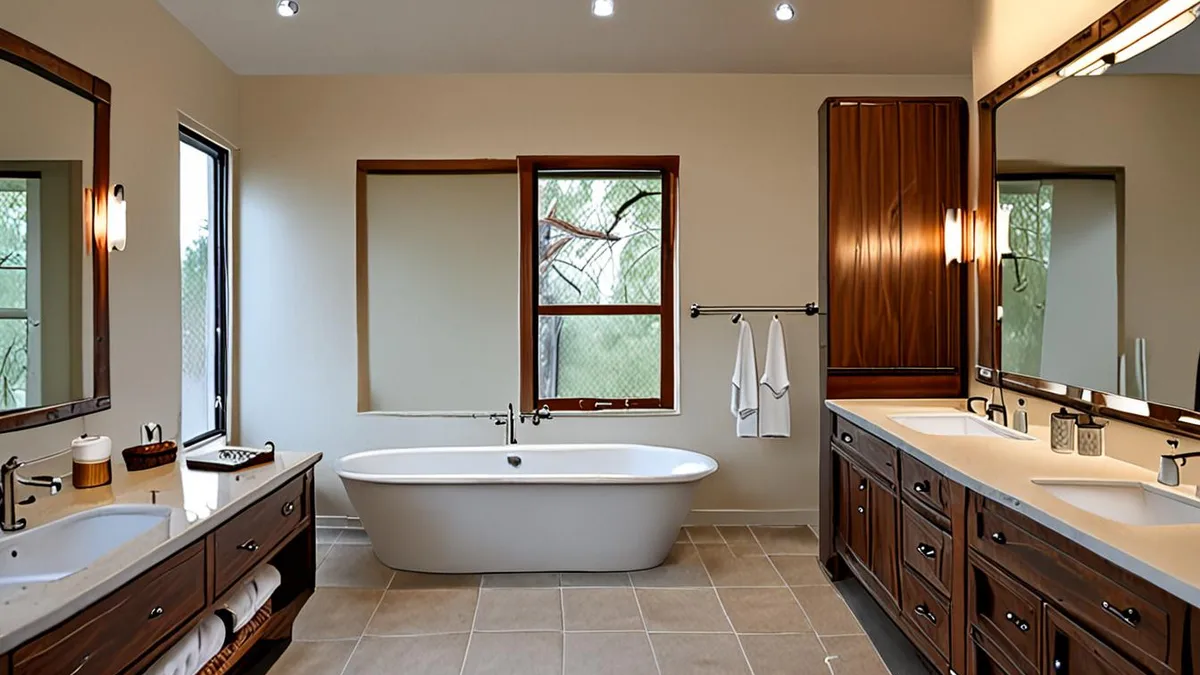
Bathrooms are where accessible stays succeed or fail, and they are also where lodge descriptions are vaguest. A room can be perfectly laid out and still be impractical if the only shower is over a step-over tub. Roll-in showers usually need at least 90 x 150 cm of floor space, so ask directly whether the shower is a true roll-in design with a flat entry, or a bathtub with a shower attachment that the brochure photo makes look accessible.
Grab rails and raised toilet seats are the features most often missing, even in lodges marketed as accessible. Confirm that rails are fitted next to the toilet and inside the shower, and ask whether a raised toilet seat or a shower chair can be provided on request if they are not permanently installed. Portable equipment is a reasonable solution, but only if you know it exists before you arrive.
The sink is easy to overlook until you are seated in front of one you cannot use. Ask about its height, whether there is clear space underneath for your knees, and whether the mirror and taps are positioned so you can reach them from your chair. A tall vessel sink with a wall-mounted mirror may look elegant in photos and be completely unusable from a seated position.
A few extra details worth adding to your questions:
- Whether the shower has a handheld showerhead on an adjustable rail, which makes independent washing far easier than a fixed overhead head.
- The position of the shower controls, since controls placed at standing height or at the far wall of the shower can defeat the purpose of a roll-in design.
- Non-slip flooring in the wet area, and whether the floor slopes gently toward a drain rather than pooling water near the doorway.
- Whether the bathroom door opens outward or slides, because an inward-opening door can be blocked by your chair if you slip or need assistance inside.
As with the room itself, ask for photos of the actual bathroom in the accessible room. A thirty-second video of someone walking through the shower area will tell you more than any written description.
Terrain and Common Areas at Remote Lodges
At a city hotel, everything you need is usually under one roof on smooth floors. At a remote lodge, the ground between buildings is part of your accessibility question. Before booking, ask exactly what surfaces connect your room to the dining area, lounge and activity spaces. Paved paths and boardwalks are workable; loose gravel and dirt are often not.
This matters most at safari and mountain lodges, which often sit on uneven, natural terrain. Gravel and dirt paths at these lodges are frequently impassable in a manual wheelchair, so ask directly whether you would need a powered wheelchair or an escort for the route between your room and the main areas. If the lodge is honest about the terrain, you can plan around it; if the answer is vague, treat that as a warning sign.
Common areas and daily routines
Inside the main building, check whether the restaurant, pool and viewing decks have ramps or step-free routes. A ramp should have a gradient of roughly 1:12, meaning 1 cm of rise per 12 cm of length; anything steeper may need help. Also ask whether staff can assist with meals if the dining setup is difficult to reach. If you want a sense of how the day is structured at a game-drive lodge, reading about safari lodge facilities and the daily routine will help you picture which routes you will actually use.
Booking an Accessible Lodge Room: Timing and Confirmation
The biggest practical constraint with accessible lodge rooms is simple supply. Accessible rooms are usually limited to 1-2 per lodge, so for high-season dates you should aim to book 3-6 months ahead. Waiting until the last minute often means choosing between an unsuitable room and a different lodge entirely. Our guide to when to book lodge stays and how seasons affect prices can help you time it right.
Get it in writing
Phone descriptions of access features are often inaccurate, so get every feature confirmed in writing by email. List your requirements specifically: doorway widths, step-free entry, roll-in shower, grab rails and any equipment you need. A written reply from the lodge gives you something concrete to hold them to, and it forces someone who has actually seen the room to answer.
While you have the lodge on email, ask about cancellation terms specifically for the accessible room. If you arrive and the confirmed features turn out to be missing, you need to know what your options are before you have paid in full. Some lodges will offer a refund or an alternative; others will not unless you asked in advance.
Finally, reconfirm your requirements 2-4 weeks before arrival. This gives housekeeping time to prepare equipment such as a shower chair or raised toilet seat, and it puts your booking back on the radar of the person who will actually set up your room.
Matching Wheelchair Access to Your Lodge Destination
Wheelchair access means different things at different kinds of lodges, so it pays to match your questions to your destination. A feature that matters enormously at one type of lodge may be irrelevant at another.
Alpine and mountain lodges
Alpine and mountain lodges are often built on slopes, which means split levels, short flights of stairs and wings connected by steps. At these lodges, a single-level wing matters more than the features of any individual room. A perfect roll-in shower is little use if you cannot reach the restaurant without climbing three steps. Ask whether there is a step-free route from an accessible room to the dining and lounge areas, and whether a ramp with a gradient of roughly 1:12 connects any level changes.
Safari, glass and lakeside lodges
Safari lodges bring a different challenge: the game drives themselves. Many rely on open 4×4 vehicles with high step-over heights, so ask specifically about vehicle transfer assistance. Find out whether staff are trained to help with transfers, whether any vehicle has been adapted, and how much notice they need to arrange support.
Glass-fronted and lakeside lodges frequently use boardwalks to link rooms to main areas, and these can be ideal for wheelchair users. The key details are the gradients and the surface: gentle slopes and firm, non-slip decking work well, while steep sections or gaps between boards do not. Ask for the boardwalk’s route and gradient before you assume it is accessible, and request photos or a video walkthrough to confirm what you are being told.
Wrapping Up Your Accessibility Check
The word “accessible” on a lodge website tells you almost nothing on its own. What matters is whether the doorways are wide enough, whether there is a true roll-in shower, and whether you can move step-free from your room to the dining area and beyond. By asking specific questions about each of these features, you replace a vague label with real answers you can rely on.
Two habits prevent most problems: getting every confirmed feature in writing, and booking early, since accessible rooms are usually limited to 1-2 per lodge. It also pays to tailor your questions to the destination, because a remote safari lodge and an alpine lodge each bring their own terrain challenges. If a lodge cannot answer clearly, treat that as your answer. Has a lodge description ever let you down, or did good questions save your stay? Share your experience in the comments below.